T700 and T800 are Toray carbon fiber grade families widely used in structural composite manufacturing.
Both are polyacrylonitrile-based fibers positioned within standard and intermediate modulus classes for demanding CFRP laminates.
T700 typically appears as T700S or T700G, while T800 includes T800S and T800H variants from Toray. Each variant carries slightly different sizing or filament count options for specific prepreg and fabric constructions.
T700 vs T800: Key Differences
The primary differences between T700 and T800 involve tensile strength, modulus, strain capability, processing sensitivity, cost, and application requirements.
| Property | T700 Carbon Fiber | T800 Carbon Fiber |
|---|---|---|
| Modulus class | Standard modulus | Intermediate modulus |
| Typical tensile strength | Approximately 4,900 MPa | Often 5,880 MPa or higher |
| Typical tensile modulus | Approximately 230 GPa | Approximately 294 GPa |
| Handling | Easier spreading and draping | Requires tighter handling control |
| Cost | Lower | Higher |
| Common use | Industrial parts, pressure vessels, and sporting goods | Aerospace structures and weight-critical components |
Tensile Performance
Tensile Strength
T800 fiber typically exhibits higher filament tensile strength than T700, often exceeding 5,880 MPa compared to approximately 4,900 MPa for T700.
This difference reflects fiber-level capability and does not automatically translate into equivalent laminate strength.
Laminate strength depends on fiber volume fraction, ply orientation, and resin performance.
Tensile Modulus
T800 fiber generally offers a higher tensile modulus near 294 GPa, compared to about 230 GPa for T700.
The increased modulus improves stiffness-critical designs where deflection control matters more than raw strength.
Strain to Failure
T800 fiber typically shows greater strain to failure than T700, supporting improved toughness under sudden loading.
Higher strain capability helps resist brittle fracture in impact-sensitive structural regions.
Fiber vs Laminate Properties
Fiber-level tensile values describe filament behavior under controlled test conditions, not finished component performance. The table below shows the main factors that determine whether fiber properties translate into structural performance.
| Factor | Effect on Laminate Performance |
|---|---|
| Fiber volume fraction | Controls how much of the load is carried by the reinforcement |
| Ply orientation | Determines strength and stiffness along each loading direction |
| Resin toughness | Affects cracking, impact resistance, and interlaminar performance |
| Void content | Reduces compression strength and fatigue life |
| Fiber alignment | Influences tensile efficiency and microbuckling resistance |
| Cure quality | Affects resin properties and fiber-to-matrix load transfer |
Laminate Performance
Compression Strength
T800 laminates often demonstrate improved compression strength due to higher modulus and better fiber straightness.
Compression failure frequently initiates through microbuckling, which is sensitive to fiber waviness regardless of grade.
T700 laminates can achieve strong compression performance when fiber alignment is tightly controlled during layup.
Processing discipline often influences compression results more than the strength class alone.
Fatigue Resistance
T800 fiber generally supports improved fatigue resistance because of its higher strain tolerance and modulus. T700 remains suitable for many fatigue-loaded components when laminate design manages stress concentrations effectively.
Impact Damage
Higher strain capability in T800 can improve resistance to impact-induced fiber breakage. Resin toughness and stacking sequence still strongly influence impact damage tolerance in both grades.
Manufacturing and Laminate Design
Sizing and Fiber Handling
T800 fiber often requires more controlled handling due to its higher stiffness and reduced tow flexibility. T700 tends to spread and drape more easily during manual layup operations.
Resin Compatibility
Both grades work with epoxy, bismaleimide, and other structural resin systems used in aerospace-grade prepreg.
Resin selection depends on required service temperature and toughness rather than fiber grade alone.
Fiber Volume and Void Content
Achieving a consistent fiber volume fraction near 60 percent supports predictable laminate strength for either grade.
Elevated void content reduces compression and fatigue performance regardless of fiber tensile capability.
Ply Orientation and Fiber Waviness
Fiber waviness reduces compression strength more significantly in higher-modulus T800 laminates. Careful ply placement and tension control during layup help prevent localized fiber misalignment.
Cost and Availability
Raw Material Cost
T800 fiber generally costs more than T700 due to tighter manufacturing tolerances and stricter quality control. The added cost reflects processing precision rather than a proportional strength gain alone.
Tow Sizes and Supply
T700 is widely available in 12K tow configurations suited for high-volume production. T800 commonly appears in 12K or 24K formats used in qualified aerospace prepreg systems.
Processing and Qualification Costs
T800 often requires more extensive process qualification for aerospace applications, increasing engineering and testing expenses. T700 typically involves a lower qualification burden for industrial and sporting goods manufacturing.
Applications
The appropriate grade depends on structural requirements, production controls, qualification standards, and acceptable material cost.
- Aerospace structures: T800 is frequently selected for primary structures requiring higher stiffness-to-weight performance. T700 remains common in secondary structures where additional qualification cost is difficult to justify.
- Pressure vessels: T700 is widely used in filament-wound vessels because of its strong hoop tensile performance and cost efficiency. T800 may be used where lower weight or additional stiffness is required.
- Sporting goods: T800 supports premium products where low weight and high stiffness strongly affect performance. T700 remains common in products balancing strength, cost, and manufacturing simplicity.
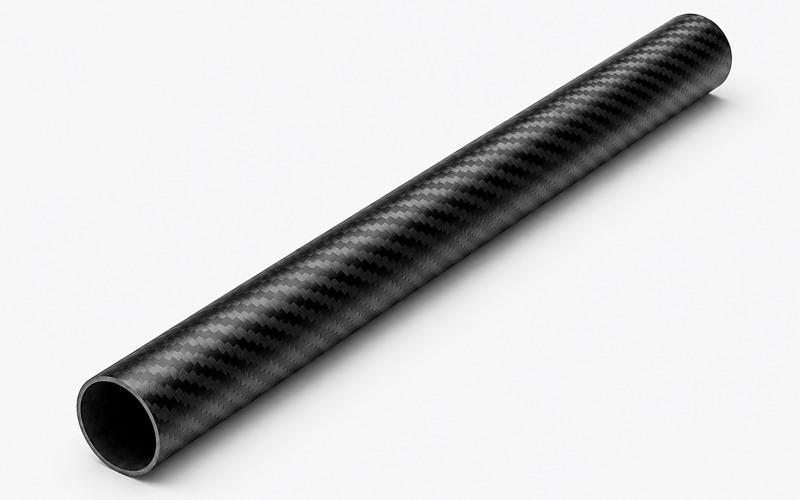
Similar fiber-selection principles also apply to structural carbon fiber tubes, where stiffness, wall thickness, fiber orientation, and manufacturing method determine finished-part performance.
Choosing Between T700 and T800
Fiber selection should begin with the required laminate properties rather than the grade name alone.
- Choose T800 when the design requires higher stiffness, improved compression performance, greater strain capability, or additional weight reduction.
- Choose T700 when strong tensile performance, wider availability, simpler processing, and lower material cost are the main priorities.
- Evaluate the full laminate by considering thickness, ply schedule, load direction, resin system, fiber volume fraction, void control, and manufacturing capability.
- Confirm the value of upgrading through laminate testing rather than assuming the higher fiber grade will automatically produce a stronger component.
If T700 may already exceed the required performance, compare T300 vs T700 carbon fiber before specifying a higher-cost grade.
For applications requiring another step in tensile capability, compare T800 vs T1000 carbon fiber.
FAQ
Is T800 Stronger and Stiffer Than T700?
T800 fiber generally shows higher tensile strength and modulus than T700 at the filament level. Laminate performance still depends on processing quality and structural design.
Does a Higher Grade Make a Stronger Part?
A higher fiber grade does not automatically guarantee a stronger finished component. Resin quality, fiber alignment, and void control often determine actual laminate strength.
Can T700 and T800 Be Used Together?
Engineers sometimes combine T700 and T800 within hybrid laminates to balance cost and stiffness. Compatibility depends on the resin system and ply-level load distribution.
Is T800 Always Better for Aerospace Parts?
T800 is not universally required for every aerospace component. Many secondary structures perform reliably using T700 at a lower qualification cost.
Why Is T800 More Expensive Than T700?
T800 involves tighter manufacturing control and stricter quality standards than T700. These requirements increase raw material and qualification expenses.