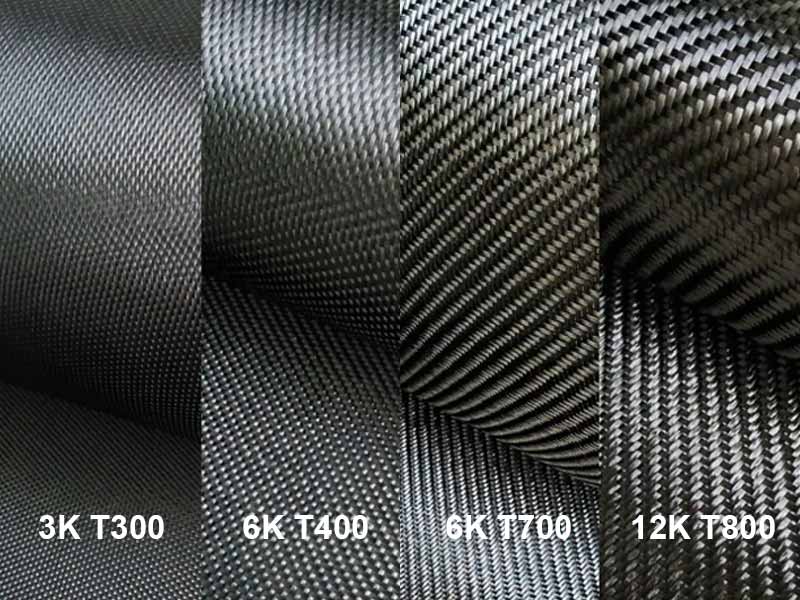
T700 and T1000 identify Toray carbon fiber grade families used across industrial and aerospace composite manufacturing. Both are PAN-based fibers, but they occupy different positions on the strength and modulus spectrum.
T700S is a standard-modulus, high-strength fiber widely used in general industrial composites. T700G and T1000G represent later product variants with refined filament consistency and processing behavior.
PAN-Based Carbon Fiber Structure
Both grades originate from polyacrylonitrile precursor fiber that is oxidized and carbonized into continuous filaments. Processing temperature and tension control during carbonization influence filament crystallinity, which affects strength and stiffness outcomes.
Why Grade Names Do Not Define a Finished Part?
A fiber grade describes filament-level mechanical properties measured under controlled test conditions. Finished part performance depends on resin system, fiber volume fraction, ply orientation, and curing quality, not the grade name alone.
T700 vs T1000 Property Comparison
Direct comparison of measured fiber properties clarifies where T1000G offers a technical advantage over T700 grades.
Property Comparison Table
| Property | T700S | T1000G | Design Significance |
|---|---|---|---|
| Tensile strength | Approximately 4,900 MPa | Approximately 6,370 MPa | T1000G provides higher filament-level tensile load capacity. |
| Tensile modulus | Approximately 230 GPa | Comparable modulus range | The stiffness difference is much smaller than the strength difference. |
| Strain at failure | Lower | Higher | T1000G can tolerate greater tensile strain before filament fracture. |
| Density | Approximately 1.8 g/cm3 | Approximately 1.8 g/cm3 | Both grades provide a similar weight basis for laminate design. |
| Common tow format | Often available in 12K industrial formats | Frequently supplied in smaller, specialized tow formats | Tow size affects fabric construction, handling, and layup resolution. |
| Typical positioning | High-strength industrial carbon fiber | Ultra-high-strength performance carbon fiber | T1000G targets applications with stricter weight and strength limits. |
Tensile Strength
T1000G delivers noticeably higher filament tensile strength than T700S, which supports higher load capacity per unit cross-section.
This advantage applies at the filament level and does not automatically transfer at the same ratio to a cured laminate.
Tensile Modulus
Tensile modulus between T700 and T1000G remains relatively similar, since both belong to comparable stiffness classes. Designers seeking significant stiffness gains typically look toward intermediate- or high-modulus fiber families rather than strength-focused grades.
Strain at Failure
T1000G exhibits higher elongation at break compared with T700S, giving it greater strain capability before filament fracture.
Higher strain capacity can benefit impact-prone structures, provided the surrounding laminate design supports that behavior.
Density and Filament Diameter
Both grades maintain a density near 1.8 g/cm3, with filament diameters in a similar micrometer range. These parameters affect fiber packing and resin penetration more than they affect strength comparison directly.
Tow Size and Linear Density
T700S is commonly available in 12K tow format for broad industrial use, while T1000G is frequently supplied in smaller tow counts suited to precision aerospace layup. Tow selection affects fabric weight and layup resolution rather than filament-level strength.
What the Property Differences Mean?
Interpreting the property differences requires separating strength-driven requirements from stiffness, manufacturing, and damage-tolerance constraints.
- Strength-limited designs: Structures governed by peak tensile load, such as thin-walled pressure vessels, can benefit from the higher stated strength of T1000G. The advantage becomes meaningful only when fiber alignment and resin load transfer preserve that strength through the laminate.
- Stiffness-limited designs: When deflection control governs part design, the similar modulus range between T700 and T1000G limits the stiffness advantage. Engineers often adjust ply orientation, laminate thickness, or stacking sequence instead of upgrading the fiber grade.
- Weight reduction: Higher filament strength may permit a thinner laminate under tension-dominated loading. Actual weight savings depend on whether compression, fatigue, buckling, or joint strength becomes the next limiting factor.
- Stress concentrations: Bolt holes, bonded joints, cutouts, and ply drops create localized stresses that can offset raw fiber strength gains. Design safety factors can further reduce the practical benefit of T1000G in these regions.
Fiber Properties vs Finished Part Performance
Laminate performance depends on manufacturing quality as much as filament-level mechanical data.
Resin and Fiber-Matrix Interface
Resin chemistry and fiber sizing affect load transfer between filaments and matrix. A mismatched resin system can prevent either T700 or T1000G from reaching its rated tensile capability within a cured part.
Fiber Volume Fraction and Void Content
Fiber volume fraction and void content strongly influence laminate strength regardless of fiber grade.
Elevated void content can reduce effective strength enough to erase the theoretical gap between T700 and T1000G.
Fiber Orientation and Laminate Thickness
Off-axis loading reduces the usable benefit of high filament strength, since fibers perform best when aligned with primary load paths. Laminate thickness and ply stacking sequence further determine how efficiently fiber-level properties convert into part-level strength.
Compression Performance in a Laminate
Compressive strength depends heavily on fiber straightness and resin support against microbuckling. T1000G filaments do not guarantee higher compressive performance if fiber waviness or resin-rich zones are present.
Fatigue and Impact Damage
Higher strain capability in T1000G can support improved impact tolerance in well-consolidated laminates. Fatigue life still depends on void content, ply interface quality, and cyclic load direction rather than fiber grade alone.
Material Forms and Processing
Processing behavior differs between T700 and T1000G due to tow characteristics and quality requirements.
Tow Availability and Material Formats
T700S is widely available in dry tow, prepreg, and woven fabric formats for industrial production.
T1000G availability is more limited and often targeted toward aerospace-qualified prepreg systems.
Sizing and Resin Compatibility
Fiber sizing chemistry affects wet-out speed and adhesion strength with a given resin system. Both grades require sizing compatible with the intended resin to avoid interface weakness during cure.
Filament Winding and Prepreg Processing
T700 tow is commonly used in filament winding for pressure vessels due to established process data and cost efficiency. T1000G prepreg systems require tighter process control to preserve their higher strain and strength characteristics during layup and cure.
Filament Size and Tow Handling
Finer tow configurations associated with T1000G can improve layup precision but require careful tension control to avoid filament damage. Handling errors that cause fiber breakage reduce the practical strength advantage before the part reaches cure.
Quality Control and Defect Management
Aerospace-grade T1000G laminates typically require stricter inspection for voids, misalignment, and resin distribution.
Industrial T700 applications often tolerate broader process windows due to lower certification demands.
Cost and Availability
Cost differences reflect production complexity, supply volume, processing control, and qualification requirements rather than fiber strength alone.
| Cost Factor | T700S | T1000G |
|---|---|---|
| Raw material price | Lower due to broader industrial production | Higher due to tighter manufacturing tolerances and specialized demand |
| Availability | Widely distributed in multiple material forms | More limited and concentrated in specialized supply channels |
| Lead time | Generally shorter for common tow and prepreg formats | Can be longer for qualified or program-specific materials |
| Processing cost | Compatible with established industrial manufacturing processes | Often requires tighter handling, curing, and inspection controls |
| Traceability | Depends on the application and supplier requirements | Frequently includes aerospace-grade documentation and batch control |
| Total component cost | Usually lower when standard performance is sufficient | Higher after labor, inspection, scrap, and qualification costs are included |
Material Price and Procurement Volume
T1000G carries a higher raw material price than T700S due to tighter manufacturing tolerances and lower production volume. Procurement cost per kilogram may narrow at higher order volumes but generally remains above standard T700 pricing.
Supply Options and Lead Time
T700 benefits from broad global distribution and shorter lead times across multiple industries. T1000G sourcing is more concentrated, which can extend lead time for specialized aerospace programs.
Qualification and Traceability Costs
Aerospace use of T1000G often requires full material traceability and process qualification documentation. These requirements increase engineering and administrative costs beyond the fiber price itself.
Total Part Cost vs Fiber Price
Total component cost includes labor, inspection, scrap rate, and cycle time in addition to fiber price.
A part using T700 can cost less overall even when T1000G offers superior filament strength on paper.
T700 and T1000 Applications
Application choice depends on load type, weight targets, manufacturing capability, and certification requirements rather than fiber grade prestige.
Common T700S Applications
T700S serves automotive structural parts, sporting goods, industrial tanks, and general composite structures where strength and cost balance matter. Its broad process history supports predictable manufacturing outcomes across many industries.
Common T1000G Applications
T1000G is selected for aerospace primary structures and high-performance components where strain and strength margins justify the added cost. Programs using T1000G typically maintain rigorous process control to protect its performance advantage.
Pressure Vessels and Filament-Wound Structures
Type IV pressure vessels commonly use T700 due to established filament winding data and cost efficiency. Some high-performance vessel designs adopt T1000G to reduce wall thickness under strict weight targets.
Aerospace and Weight-Critical Components
Weight-critical aerospace components benefit from the higher stated strength of T1000G when combined with tightly controlled laminate quality. The fiber choice supports weight reduction only when manufacturing processes preserve its mechanical potential.
Hybrid T700 and T1000 Laminates
Hybrid laminates use T1000G in high-load regions and T700 elsewhere to balance performance and cost. This layered approach requires careful ply mapping to avoid abrupt property changes at fiber transition zones.
If T700 does not meet the required stiffness or strength target, compare T700 vs T800 carbon fiber before moving directly to T1000G.
For a closer comparison at the higher-performance end, see T800 vs T1000 carbon fiber.
How to Choose Between T700 and T1000?
Selection depends on load conditions, process capability, material availability, and budget rather than fiber reputation alone.
- Identify the governing requirement. Determine whether the component is limited by tensile strength, stiffness, compression, fatigue, impact, or buckling.
- Evaluate the loading direction. T1000G provides the greatest benefit when fibers remain aligned with tension-dominated primary load paths.
- Review the manufacturing process. Confirm that winding tension, prepreg handling, layup accuracy, curing, and inspection controls can preserve the selected fiber properties.
- Calculate part-level performance. Compare laminate properties rather than relying only on single-filament datasheet values.
- Assess cost and supply risk. Include raw material price, lead time, qualification, traceability, inspection, scrap, and production volume.
- Validate the design. Use laminate testing, process trials, and representative component tests before final material approval.
FAQ
Is T1000G Stronger and Stiffer Than T700S?
T1000G offers higher tensile strength than T700S, but their modulus values remain relatively similar. Stiffness gains should not be assumed from the strength difference alone.
Does T1000G Always Produce a Stronger Part?
Filament strength does not guarantee a stronger finished laminate without proper fiber alignment, resin compatibility, consolidation, and low void content. Manufacturing quality often determines whether the fiber advantage transfers to the part.
Is T1000G More Brittle Than T700S?
T1000G shows higher strain at failure than T700S, indicating greater tensile elongation capability rather than greater brittleness. Handling sensitivity relates more to tow configuration and filament damage than to brittleness alone.