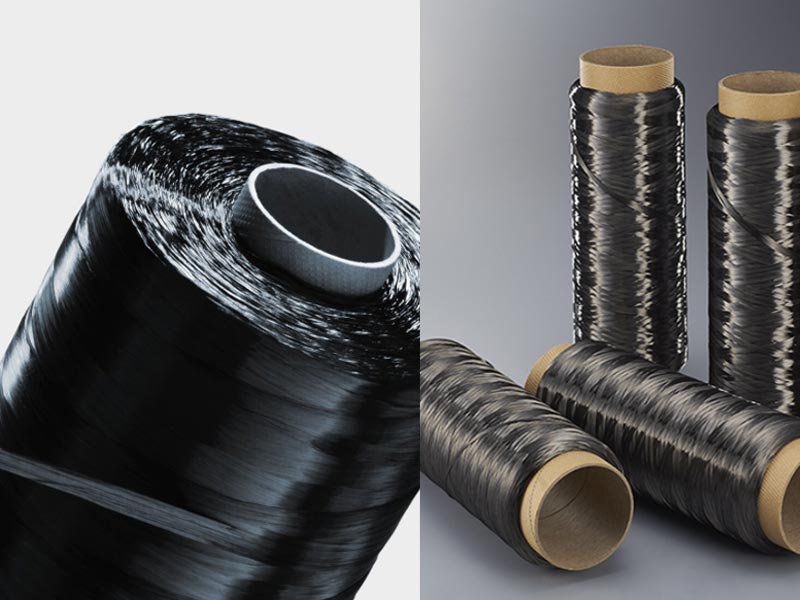
What PAN and Pitch Carbon Fibers Are?
PAN and pitch carbon fibers come from different precursor chemistries that shape their internal structure and end use.
PAN and Pitch Precursor Materials
PAN fiber originates from polyacrylonitrile, a polymer chain that carbonizes into a fine, disordered carbon structure. Pitch fiber comes from petroleum or coal tar pitch, a heavier aromatic feedstock. The precursor chemistry sets the starting molecular alignment before carbonization begins and later governs how much the fiber can graphitize under heat.
Isotropic and Mesophase Pitch Fibers
Isotropic pitch fiber has randomly oriented molecules and produces lower-strength, low-cost carbon fiber. Mesophase pitch fiber forms through thermal treatment that aligns aromatic molecules into ordered domains. Mesophase precursors enable high modulus carbon fiber grades and high thermal conductivity after graphitization, while isotropic pitch fiber remains limited to general reinforcement or insulation roles.
How Precursor Structure Affects Properties
Precursor molecular order controls crystallite size, orientation, and defect density in the finished fiber, while higher initial order allows tighter graphitic stacking during heat treatment. This structural difference explains why pitch-based fiber can reach higher stiffness while PAN fiber retains more toughness, so fiber selection often starts with this distinction rather than cost alone.
PAN vs. Pitch Fiber
PAN and pitch fibers diverge in mechanical priorities, crystalline order, thermal behavior, and commercial use.
| Comparison Area | PAN-Based Carbon Fiber | Pitch-Based Carbon Fiber |
|---|---|---|
| Design priority | Higher tensile strength and strain tolerance | Higher stiffness, especially in high modulus grades |
| Graphitic structure | More disordered and resistant to full graphitization | More ordered and easier to graphitize |
| Thermal behavior | Lower axial thermal conductivity and near-neutral expansion | High axial conductivity and often slightly negative expansion |
| Damage tolerance | More tolerant of impact, cyclic loading, and handling | More brittle and sensitive to microcracking |
| Availability | Widely produced through established supply chains | Supplied mainly for specialty stiffness and thermal applications |
| Typical use | Load-bearing aerospace, automotive, and industrial structures | Precision structures, heat spreaders, and satellite components |
PAN vs Pitch Carbon Fiber Properties
Comparing representative grades highlights how precursor choice shifts strength, modulus, strain capacity, and specific performance.
| Property | PAN-Based Carbon Fiber | Pitch-Based Carbon Fiber | Design Effect |
|---|---|---|---|
| Tensile strength | Generally higher | Generally lower in high modulus grades | PAN suits structural load paths and fatigue-loaded parts |
| Tensile modulus | Lower but balanced with strain tolerance | Can exceed 800 GPa in ultra-high modulus grades | Pitch reduces deflection in rigidity-critical structures |
| Failure strain | Higher elongation before fracture | Lower strain due to a rigid graphitic structure | PAN offers better impact and handling tolerance |
| Density | Usually slightly lower | Often slightly higher in high modulus grades | Pitch can still provide greater specific stiffness |
| Primary advantage | Strength, toughness, and durability | Stiffness, dimensional stability, and conductivity | Selection depends on the dominant laminate requirement |
Compression and Damage Resistance
Compression behavior and damage tolerance differ sharply between PAN and pitch reinforced laminates.
Compression Performance in Composites
PAN fiber composites generally show stronger compression performance due to higher failure strain and toughness. Pitch fiber laminates, particularly high modulus types, show reduced compressive strength from brittle fracture behavior. Compression strength also depends on fiber alignment, resin support, and void content, with poor alignment lowering load capacity regardless of fiber type.
Fiber Brittleness and Handling Damage
High modulus pitch fiber is more brittle and prone to microcracking during handling or cutting. Careless tooling or sharp bend radii can create hidden fiber breakage before curing. This sensitivity raises the importance of controlled handling because damage introduced before layup often remains undetected until mechanical testing.
Why Laminate Design Affects Failure
Ply stacking sequence, resin content, and fiber volume fraction influence how a laminate resists compressive failure. Poor design can trigger delamination or fiber microbuckling under load. Engineers can offset brittleness in high modulus pitch plies through adjusted layup schedules or hybrid stacking with PAN plies.
Thermal and Electrical Performance
Thermal and electrical behavior separate pitch and PAN fiber composites in demanding environments.
Axial Thermal Conductivity
Graphitized pitch fiber conducts heat far more efficiently along its axis than PAN fiber, supporting heat-dissipating structures in electronics and spacecraft panels.
Thermal Anisotropy in Laminates
Carbon fiber laminates conduct heat unevenly, with strong axial flow and weak through-thickness flow. Pitch fiber sharpens this anisotropy due to its higher intrinsic conductivity. Laminate designers orient plies strategically to direct heat toward desired exit paths because poor orientation can trap heat and create localized thermal stress.
Coefficient of Thermal Expansion
High modulus pitch fiber often exhibits slightly negative axial thermal expansion, which can offset resin expansion. PAN fiber shows near-neutral expansion and offers more predictable dimensional behavior across temperature swings.
Electrical Resistivity and Conductivity
Graphitized pitch fiber shows lower electrical resistivity than PAN fiber due to its ordered carbon structure, supporting applications that require electromagnetic shielding or grounding paths.
How PAN and Pitch Fibers Are Made?
Manufacturing routes diverge during precursor preparation and spinning, then converge during carbonization and finishing.
- PAN spinning and stabilization: PAN precursor forms through wet or dry-jet spinning, followed by oxidative stabilization near 250°C. Stabilization cross-links the polymer chain and prevents melting during carbonization. Poor tension or temperature control can cause shrinkage and uneven fiber geometry.
- Pitch refining and melt spinning: Pitch feedstock is refined to remove impurities before melt spinning into continuous filaments. Mesophase pitch requires precise thermal control to develop aligned liquid crystal domains. Contamination or unstable spinning temperatures can reduce filament uniformity and strength.
- Carbonization and graphitization: Both fiber types are heated to remove non-carbon elements and develop a graphitic lattice. Pitch fiber often receives higher-temperature graphitization to maximize modulus and conductivity. Excessive heat treatment can increase brittleness.
- Surface treatment and sizing: Surface oxidation increases reactivity for stronger fiber-resin adhesion. A sizing layer then protects the filaments during weaving, prepreg production, and handling.
Composite Processing Differences
Processing behavior varies between PAN and pitch fiber due to stiffness and brittleness differences.
Weaving and Prepreg Processing
PAN fiber tolerates weaving and braiding with fewer breakages due to its higher strain capacity. Pitch fiber, especially high modulus grades, requires gentler tension control to avoid filament fracture.
Surface Treatment and Resin Compatibility
Surface treatment intensity must match fiber chemistry to achieve stable resin bonding because inadequate treatment can cause weak interfacial adhesion and premature delamination under load.
Handling and Layup Requirements
Pitch fiber demands careful handling during cutting, draping, and compaction to prevent microcracking. PAN fiber allows more forgiving layup procedures across complex geometries. Operators often use lower compaction pressure for brittle pitch plies to reduce the risk of localized fiber damage.
Quality Control and Material Qualification
Qualification testing verifies tensile strength, modulus, and void content against specified acceptance limits. Pitch fiber laminates often require additional inspection for microcracking after machining.
PAN and Pitch Carbon Fiber Applications
Different carbon fiber applications prioritize strength, stiffness, dimensional stability, or thermal performance differently.
- PAN structural components: Aerospace primary structures, automotive panels, pressure vessels, and other load-bearing CFRP parts that require strength and fatigue resistance.
- Pitch thermal management parts: Heat sinks, satellite radiators, electronic housings, and panels that direct heat along a controlled path.
- Pitch precision structures: Optical benches, antenna supports, and dimensionally stable assemblies exposed to wide temperature changes.
- Hybrid PAN and pitch laminates: Structures combining PAN plies for toughness with pitch plies for stiffness, low expansion, or thermal conductivity.
Cost and Material Availability
Cost differences reflect feedstock complexity, production scale, and qualification effort.
Feedstock Cost and Process Complexity
Pitch refining and mesophase development add processing steps that increase production cost. PAN precursor manufacturing benefits from mature, large-scale polymer production infrastructure.
Production Scale and Supplier Availability
PAN fiber suppliers operate at a larger scale, improving lead time and price stability, while pitch fiber remains limited to specialized producers serving thermal and stiffness-critical markets.
Qualification and Program Cost
Switching fiber types often requires new mechanical testing and process validation. Qualification cost can outweigh raw material savings for small production programs.
FAQ
Is PAN or Pitch Carbon Fiber Stronger?
PAN fiber generally offers higher tensile strength, while pitch fiber prioritizes stiffness over strength.
Which Carbon Fiber Has Higher Modulus?
High modulus pitch fiber significantly exceeds the modulus of typical PAN fiber. This makes pitch fiber preferable for rigidity-critical structures.
Which Fiber Has Higher Thermal Conductivity?
Graphitized pitch fiber conducts heat more efficiently than PAN fiber, supporting thermal management applications that require directional heat flow.
Is All Pitch Carbon Fiber High Modulus?
No, isotropic pitch fiber has low modulus and limited performance. Only mesophase pitch fiber achieves high modulus after graphitization.
Can PAN and Pitch Fibers Be Combined?
Yes, hybrid laminates combine PAN toughness with pitch stiffness or conductivity to provide more balanced performance.