ABS and carbon fiber composites serve very different design priorities. ABS is a moldable thermoplastic suited to high-volume production, complex geometry, and ductile impact behavior. Carbon fiber composite uses oriented reinforcement to provide much higher stiffness, strength, fatigue resistance, and dimensional stability.
What Are ABS and Carbon Fiber Composites?
ABS and carbon fiber composites differ in internal structure, manufacturing method, and load-bearing behavior. ABS is a homogeneous thermoplastic, while carbon fiber composite combines reinforcement fibers with a polymer matrix.
ABS Thermoplastic Structure
ABS is an amorphous thermoplastic made from acrylonitrile, butadiene, and styrene.
Each component contributes a different property to the finished material.
The butadiene phase improves toughness and impact absorption.
Styrene supports surface finish and processability, while acrylonitrile contributes chemical resistance and thermal stability.
Carbon Fiber Composite Structure
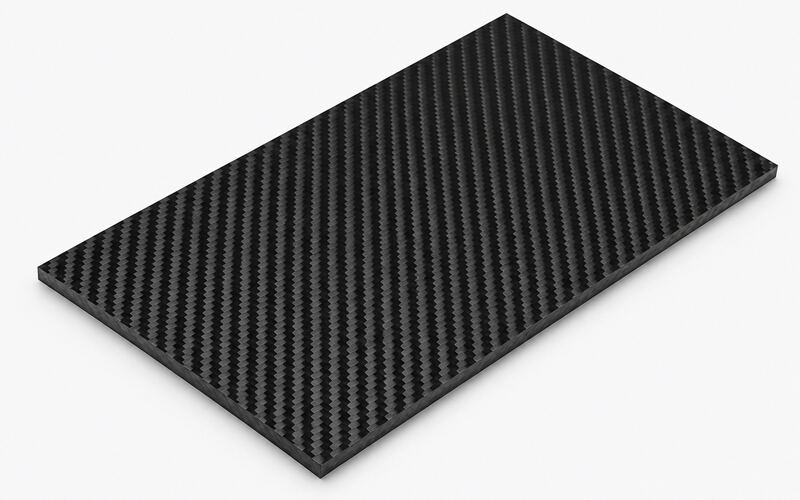
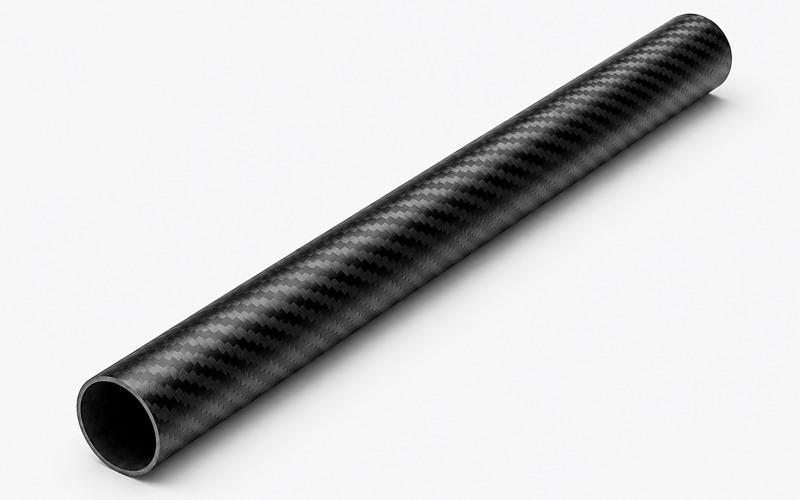
Carbon fiber composite contains continuous or discontinuous carbon reinforcement embedded in a cured resin matrix.
Structural laminates commonly use epoxy resin and aligned woven or unidirectional fibers.
Fiber volume fraction, resin content, ply orientation, and cure quality govern laminate performance.
Carbon-Look ABS vs Real Carbon Fiber
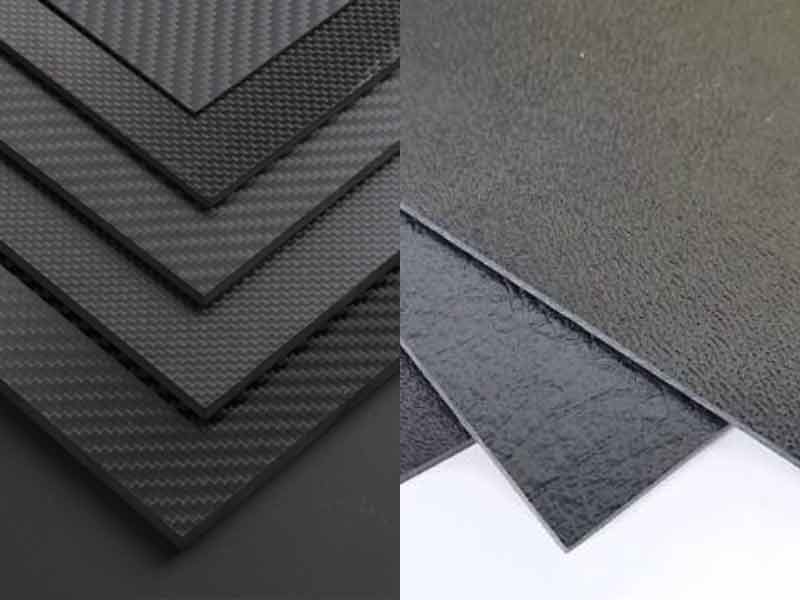
Carbon-look ABS uses a molded texture, printed film, hydrographic pattern, or decorative coating to imitate woven carbon fiber.
The pattern provides appearance only and does not add structural reinforcement.
Real carbon fiber contains visible fiber tows that carry mechanical loads through the laminate. Its structural performance comes from the reinforcement rather than the surface pattern.
Differences Between ABS and Carbon Fiber
ABS and carbon fiber composites differ in density, stiffness, impact behavior, temperature resistance, manufacturing scale, and cost structure.
| Property | ABS | Carbon Fiber Composite |
|---|---|---|
| Material structure | Unreinforced thermoplastic made from acrylonitrile, butadiene, and styrene | Carbon reinforcement embedded in a cured polymer matrix |
| Typical density | Approximately 1.05 g/cm³ | Typically around 1.5 to 1.6 g/cm³ |
| Tensile strength | Moderate and relatively uniform in different directions | Much higher along the primary fiber direction |
| Elastic modulus | Low modulus with greater deflection under load | High modulus with strong resistance to bending |
| Impact behavior | Deforms plastically and absorbs energy before fracture | Resists deformation but may fail through fiber breakage or delamination |
| Fatigue resistance | Can soften, craze, or crack under repeated loading | Generally retains stiffness effectively under cyclic loads |
| Heat resistance | Softens at elevated temperatures | Maintains greater rigidity with a suitable resin system |
| Thermal expansion | Expands and contracts noticeably with temperature changes | Low expansion along the fiber direction |
| Production volume | Well suited to high-volume automated molding | Better suited to lower-volume performance parts |
| Cost structure | High tooling cost but low unit cost at scale | Higher material and labor cost per component |
| Typical use | Housings, covers, trim, enclosures, and consumer parts | Structural panels, tubes, brackets, shells, and performance parts |
Mechanical Performance
Mechanical performance depends on geometry, temperature, strain rate, material grade, and manufacturing quality. Carbon fiber provides much higher structural performance, while ABS offers greater ductility and more predictable plastic deformation.
Tensile Strength and Specific Strength
Carbon fiber laminate provides substantially higher tensile strength than ABS when loads align with the reinforcement.
This makes it suitable for components that must carry significant force without excessive weight.
ABS has lower tensile capacity but performs consistently in different directions because it does not rely on oriented continuous fibers.
Its uniform behavior simplifies the design of lightly loaded molded parts.
Elastic Modulus and Rigidity
Carbon fiber has a much higher elastic modulus than ABS.
A carbon laminate can resist bending and torsional deformation with a thinner section.
ABS bends more readily under load. Increasing rib depth, wall thickness, or section geometry can improve rigidity, but these changes add material and weight.
Impact Resistance and Fracture
ABS absorbs impact through localized yielding and plastic deformation. This ductile response can prevent sudden fracture in housings, covers, and parts exposed to accidental drops.
Carbon fiber remains rigid under moderate impact but may develop matrix cracking, delamination, or broken fibers after a concentrated strike. Damage can remain hidden beneath the outer surface.
Fatigue Under Repeated Loads
Carbon fiber composite generally performs well under repeated loading because the reinforcement fibers exhibit low creep and retain stiffness. Fatigue resistance still depends on ply orientation, resin toughness, void content, and edge quality.
ABS may gradually deform, craze, or crack under continuous cyclic stress. Elevated temperature can accelerate creep and reduce long-term dimensional stability.
Thermal and Environmental Performance
Temperature, ultraviolet exposure, chemicals, and moisture influence material life in outdoor and industrial applications.
Heat Deflection and Service Temperature
ABS begins to soften as temperature approaches its heat-deflection range.
Sustained loading near elevated temperatures may cause permanent deformation even before melting occurs.
Carbon fiber itself remains stable at much higher temperatures, but the resin matrix controls the practical service limit. High-temperature epoxy or thermoplastic matrices extend the usable range.
Thermal Expansion and Dimensional Stability
ABS expands and contracts noticeably during temperature changes.
This movement can affect clips, snap fits, covers, and precision assemblies.
Carbon fiber has very low thermal expansion along the fiber direction. This property supports dimensional stability in measuring equipment, robotics, aerospace structures, and precision fixtures.
UV and Weathering Resistance
Unprotected ABS may fade, yellow, chalk, or become brittle during prolonged ultraviolet exposure. UV-stabilized grades and protective coatings improve outdoor durability.
Carbon fibers resist ultraviolet degradation, but the exposed resin surface may discolor or erode. Outdoor carbon parts normally use a UV-resistant clear coat, paint, or protective film.
Chemical and Moisture Resistance
ABS resists many diluted chemicals and household substances but can soften, craze, or dissolve when exposed to certain solvents.
Chemical compatibility should be checked for the exact service fluid.
Carbon fiber absorbs little moisture, although water can enter the resin, voids, damaged edges, or bonded joints. The selected matrix largely determines chemical resistance.
Manufacturing Differences
ABS and carbon fiber components use different tooling, production cycles, labor inputs, and quality controls.
| Manufacturing Factor | ABS | Carbon Fiber Composite |
|---|---|---|
| Primary process | Injection molding of molten thermoplastic | Fabric or prepreg layup followed by resin curing |
| Tooling | Requires a precision injection mold | Uses composite molds, matched tools, or autoclave tooling |
| Initial tooling cost | Usually high | Can be lower for simple low-volume molds |
| Cycle time | Short automated molding cycles | Longer cutting, layup, bagging, and curing cycles |
| Labor requirement | Low after mold setup and process automation | Often requires skilled manual or automated layup |
| Load orientation | Material behavior is relatively uniform unless reinforced | Fiber direction must follow the expected load path |
| Thickness control | Controlled by mold cavity dimensions and material shrinkage | Controlled by ply count, compaction, and resin content |
| Common defects | Warping, sink marks, weld lines, and incomplete filling | Voids, delamination, dry spots, and fiber waviness |
| Scalability | Highly efficient for mass production | Slower and more suitable for specialized structural parts |
ABS Injection Molding
Injection molding heats ABS pellets until the material flows, then forces the molten polymer into a metal mold. Cooling solidifies the part before ejection.
The process supports complex shapes, ribs, bosses, clips, textures, and integrated mounting features. Once the mold is complete, cycle times can be short and dimensional repeatability can be high.
Wall thickness should remain reasonably uniform to control cooling and shrinkage. Sudden thickness changes may cause sink marks, internal stress, or warping.
Carbon Fiber Layup and Curing
Carbon fiber components are produced by placing dry fabric, prepreg, or unidirectional reinforcement into a mold. The laminate then cures under controlled heat, vacuum, or pressure.
Prepreg materials provide controlled resin content and fiber alignment. Vacuum bagging removes trapped air and compacts the layers, while autoclave pressure can further reduce voids.
Fiber orientation must match expected loads. Incorrect ply direction, fiber waviness, poor compaction, or incomplete resin cure can reduce strength even when the finished surface appears acceptable.
Appearance and Surface Finish
ABS can imitate carbon fiber visually, but appearance alone does not confirm material structure or performance.
Molded Carbon Pattern vs Woven Fiber
Carbon-look ABS often uses a repeated surface texture or printed pattern. The weave may appear perfectly uniform, flat, and identical across complex molded geometry.
Real carbon fiber shows individual fiber bundles crossing through a woven fabric. Slight tow movement, depth, and changes in reflection may be visible beneath the clear coat.
Gloss and Matte Finishes
Both materials can use gloss or matte coatings. Gloss carbon fiber highlights weave depth and reflections, while a matte coating reduces glare and creates a softer surface appearance.
ABS can be molded with a textured matte surface or painted after production. The selected finish does not change the underlying structural performance.

How to Identify Real Carbon Fiber
Real carbon fiber usually shows visible depth beneath the coating and slight variation in the woven pattern. Cut edges may reveal multiple reinforcement plies.
Printed ABS patterns appear flatter and may continue over molded details in ways that woven fabric cannot. Weight alone is not always a reliable test because part thickness and internal geometry vary.
Quality and Manufacturing Defects
Both materials require controlled processing to meet dimensional, cosmetic, and mechanical requirements.
Warping and Sink Marks in ABS
Warping develops when different regions of an ABS part cool or shrink unevenly. Poor gate location, uneven wall thickness, residual stress, and unsuitable mold temperature may contribute to distortion.
Sink marks appear where thick sections cool more slowly than surrounding walls. Rib, boss, and wall geometry should be designed to reduce local material accumulation.
Voids and Delamination in Carbon Fiber
Voids form when air or gas remains trapped inside the laminate during curing. Excess void content reduces strength and can create pathways for moisture.
Delamination occurs when adjacent layers separate. Contamination, impact damage, poor resin flow, inadequate pressure, or weak interlaminar bonding can initiate separation.
Dimensional and Surface Inspection
ABS inspection may include dimensional measurement, flatness checks, surface review, and verification of clips or mounting features. Carbon fiber inspection may also examine ply position, surface porosity, resin-rich areas, dry fiber, and fiber waviness.
Critical carbon structures may require ultrasonic or other nondestructive inspection to detect internal defects not visible at the surface.
Machining, Assembly, and Repair
Post-processing requirements differ because ABS is a homogeneous plastic and carbon fiber is a layered abrasive composite.
Cutting, Drilling, and Edge Quality
ABS can be cut and drilled with standard tools. Excessive heat should still be avoided because it may melt the edge or produce burrs.
Cutting carbon fiber requires sharp carbide or diamond-coated tooling. Incorrect speed, feed rate, or support can cause fraying, delamination, fiber pull-out, and rough edges.
Wall Thickness and Fit Accuracy
Injection-molded ABS thickness is controlled by the mold cavity, material flow, and shrinkage. Stable molding conditions support consistent fit between production parts.
Carbon fiber thickness depends on ply count, fabric weight, compaction, resin content, and local overlaps. Designers must account for laminate thickness variation near corners, seams, and reinforcement patches.
Repair and Replacement
Minor ABS damage can often be sanded, filled, bonded, welded, or repainted. Severely cracked molded clips or thin walls may be more economical to replace.
Carbon fiber repair may involve removing damaged plies and applying a bonded patch with controlled fiber orientation. Structural repair requires careful assessment because visible damage may not show the full delamination area.
ABS vs Carbon Fiber Cost
Cost depends on material, tooling, labor, production volume, quality requirements, and finishing. The lower-cost material does not always produce the lowest-cost component.
Raw Material Cost
ABS resin pellets cost substantially less than carbon fiber reinforcement and structural resin systems. Standard ABS grades are widely available for mass production.
Carbon fiber cost varies by tow size, strength grade, modulus, fabric style, prepreg format, and qualification requirements. Higher-performance grades increase material expense.
Tooling and Labor
ABS injection molds require high initial investment, particularly for large or complex components. After tooling is complete, automated production reduces labor per part.
Carbon fiber tooling can be less expensive for simple low-volume parts, but cutting, layup, vacuum bagging, curing, trimming, and inspection increase labor cost.
Low and High Production Volumes
ABS becomes highly economical at high volumes because tooling cost is distributed across many parts. It may be expensive for prototypes or very small production runs when a dedicated injection mold is required.
Carbon fiber can be practical at low production volumes because simpler molds may be used. Unit cost remains high, but the process avoids the large initial investment of complex injection tooling.
Total Component Cost
Carbon fiber usually has a higher finished-part cost. Its use is justified when weight reduction, stiffness, fatigue resistance, low thermal expansion, or structural performance creates sufficient value.
ABS remains more economical for cosmetic and lightly loaded components where mass production, moldability, and impact toughness are the main priorities.
Choosing ABS or Carbon Fiber
The correct material depends on whether the component primarily requires moldability and cost efficiency or structural stiffness and weight reduction.
When to Choose ABS
ABS is suitable when the component requires:
- Low unit cost at high production volumes
- Complex molded shapes and integrated features
- Ductile impact behavior
- Fast automated manufacturing cycles
- Easy drilling, cutting, bonding, and surface finishing
- Cosmetic housings, trim, covers, or enclosures
- Consistent molded texture or color
When to Choose Carbon Fiber
Carbon fiber composite is more suitable when the component requires:
- High tensile strength and elastic modulus
- Low weight at a specified structural stiffness
- Minimal deflection under bending or torsional loads
- Strong fatigue performance
- Low thermal expansion and dimensional stability
- Thin structural sections
- Aerospace, motorsport, robotics, or performance applications
Cosmetic vs Structural Applications
Cosmetic applications prioritize appearance, texture, moldability, and cost. Carbon-look ABS can provide the visual style of woven carbon fiber without structural performance or high material expense.
Structural applications prioritize load transfer, stiffness, fatigue life, and weight. These requirements favor genuine carbon fiber laminate with a qualified ply orientation and resin system.
Using ABS and Carbon Fiber Together
ABS and carbon fiber can be combined within one product. An ABS enclosure may carry clips, ribs, cosmetic surfaces, and integrated mounting features, while a carbon fiber panel or frame provides local stiffness.
This hybrid approach can reduce cost compared with an all-carbon component while placing reinforcement only where structural performance is needed.
FAQ
Is ABS Stronger Than Carbon Fiber?
No. Carbon fiber composite provides much higher tensile strength and stiffness along the reinforcement direction. ABS provides greater ductility and may absorb localized impact without sudden brittle failure.
Is Carbon Fiber Lighter Than ABS?
ABS has a lower material density, but carbon fiber provides much higher stiffness per unit weight. A carbon component can therefore be lighter when both parts must meet the same structural rigidity requirement.
Is Carbon-Look ABS Real Carbon Fiber?
No. Carbon-look ABS uses a decorative texture, printed pattern, or film. Real carbon fiber contains physical reinforcement tows embedded in resin.