The designation 3K vs 12K carbon fiber refers to filament count within a single reinforcement tow, not fiber grade or strength class.
A 3K tow contains approximately three thousand continuous carbon filaments bundled together. A 12K tow contains approximately twelve thousand filaments, giving it a noticeably larger cross-section.
Differences Between 3K and 12K
Tow size influences fabric scale, weight, handling behavior, and production efficiency, but does not by itself determine finished laminate strength.
| Property | 3K Carbon Fiber | 12K Carbon Fiber |
|---|---|---|
| Filament count | Approximately 3,000 filaments per tow | Approximately 12,000 filaments per tow |
| Tow width | Narrower | Wider |
| Weave pattern | Fine and tightly interlaced | Coarse with larger crossovers |
| Typical ply weight | Generally lower | Generally higher |
| Surface finish | Smoother and more refined | Bolder and more textured |
| Layup speed | Slower on large parts | Faster on large panels |
| Complex-shape handling | Better drape around tight curves | Better suited to simple geometry |
| Typical cost | Higher | Lower |
Tow Width and Weave Scale
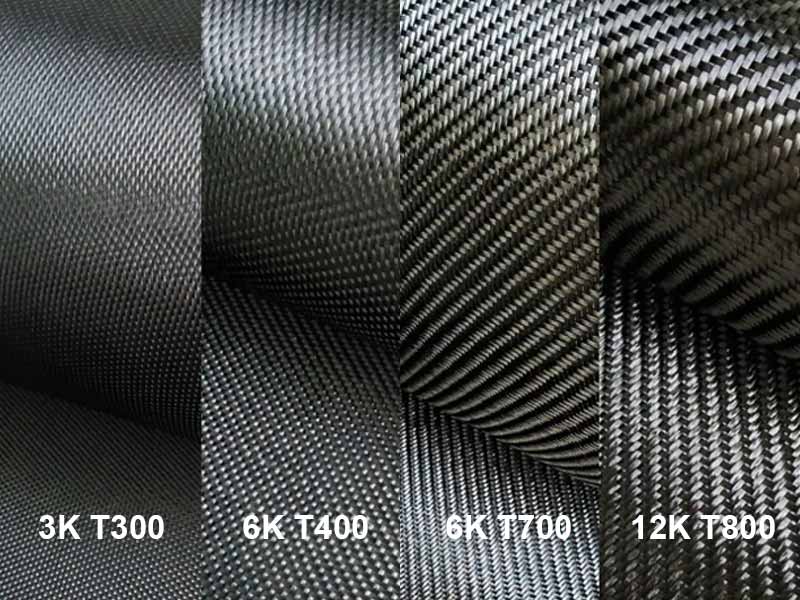
A 3K tow produces a narrower ribbon, resulting in a finer, tightly interlaced weave pattern.
A 12K tow spreads wider during weaving, creating a coarser pattern with larger visible crossovers.
This width difference directly affects how many tows fit per unit length of fabric. Wider 12K tows cover more area per pass, which changes fabric construction and layup planning.
Fabric Weight and Thickness
Fabric areal weight depends on tow size combined with weave density and thread count, not tow size in isolation.
A common 3K plain weave fabric may specify around 200 grams per square meter, while comparable 12K fabrics often reach higher areal weights because of thicker tow bundles.
Cured ply thickness follows a similar pattern because thicker fabric plies build laminate thickness faster.
Engineers select fabric weight based on target laminate thickness and ply count rather than tow size alone.
Surface Appearance
Fine 3K weaves produce a tighter, more uniform surface pattern favored in cosmetic applications. Coarser 12K weaves show larger tow crossovers, which some designs use intentionally for a bolder visual texture.
Common Applications
3K fabric suits small components, thin skins, and visible cosmetic carbon fiber panels where pattern fineness matters.
12K fabric suits larger structural panels and thicker laminates where material placement efficiency reduces layup time.
Fabric Structure and Handling
Fabric construction and tow spreading affect carbon fiber cutting, positioning, and laminate buildup.
| Manufacturing Factor | 3K Fabric | 12K Fabric |
|---|---|---|
| Tow shape | Narrower and easier to flatten | Bulkier unless mechanically spread |
| Ply buildup | More plies for target thickness | Fewer plies for target thickness |
| Thickness control | Finer increments | Larger increments |
| Cut-edge stability | Tighter weave and less fraying | Greater risk of edge fraying |
| Layup labor | Generally higher | Generally lower |
| Surface uniformity | Naturally finer | Improved through spread-tow processing |
Conventional and Spread Tows
Conventional 12K tows retain a rounder bundle cross-section unless mechanically spread during weaving.
Spread-tow processing flattens the bundle, reducing crimp and improving surface uniformity for both tow sizes.
Spreading also narrows the surface-quality difference between fine and coarse tow fabrics. Manufacturers select spread-tow fabric when appearance requirements exceed what standard weaving provides.
Ply Build-Up
Because 12K fabric often carries higher areal weight per ply, fewer plies are needed to reach a target laminate thickness. 3K fabric requires more plies for the same thickness, increasing labor time but permitting finer thickness control.
Cutting and Layup Stability
Fine 3K weaves tend to fray less at cut edges because of tighter interlacing between tows. Coarser 12K fabric may show more edge fraying and requires careful handling to prevent tow gaps during placement.
Resin Flow and Laminate Quality
Resin behavior during layup depends on fabric construction, resin viscosity, and process method, with tow size acting as one contributing factor.
Resin Wet-Out
Narrower 3K tows wet out quickly because resin travels a shorter distance through each bundle.
Thicker 12K tows require longer penetration paths, which can slow wet-out under manual layup conditions.
Voids and Dry Spots
Incomplete resin penetration into dense 12K tow bundles raises the risk of internal voids if pressure or vacuum consolidation is insufficient. Proper resin selection and infusion pressure reduce dry-spot risk regardless of tow size.
Resin-Rich Areas and Tow Gaps
Coarser 12K weaves create larger interstitial gaps between tows, which resin fills during layup.
These gaps can form resin-rich pockets that affect local stiffness when fiber volume fraction falls below design targets.
Strength and Structural Performance
Comparing 3K vs 12K carbon fiber strength requires separating tow size from fiber grade and laminate design.
- Tow size defines filament count: It describes how many filaments are bundled within one tow, not their tensile strength or modulus.
- Fiber grade defines filament properties: Grades such as T300 and T700 determine strength, stiffness, and strain capability.
- Fiber orientation controls load transfer: Fibers aligned with the primary load direction contribute more effectively to laminate strength.
- Fiber volume fraction affects efficiency: Poor consolidation or excessive resin reduces the structural contribution of either tow size.
- Laminate design remains decisive: Ply schedule, stacking sequence, total thickness, and cure quality influence performance more than tow size alone.
Tow Size vs Fiber Grade
Tow size describes filament count per bundle, while a fiber grade such as T300 or T700 describes filament tensile strength and modulus. A 12K tow made from standard-modulus fiber does not automatically outperform a 3K tow made from a higher-strength grade.
Selecting tow size and fiber grade independently helps engineers balance surface-finish requirements against mechanical targets. Confusing the two specifications can lead to incorrect material substitution.
Fiber Orientation and Volume Fraction
Finished laminate strength depends heavily on fiber orientation relative to the applied load and the achieved fiber volume fraction. A well-consolidated 3K laminate can match or exceed a poorly consolidated 12K laminate despite the smaller tow size.
How Laminate Design Affects Strength
Ply schedule, stacking sequence, and total laminate thickness determine load-carrying capacity far more than tow size alone.
Designers select tow size for processing efficiency and surface requirements, then verify performance through laminate-level testing.
Appearance and Surface Finish
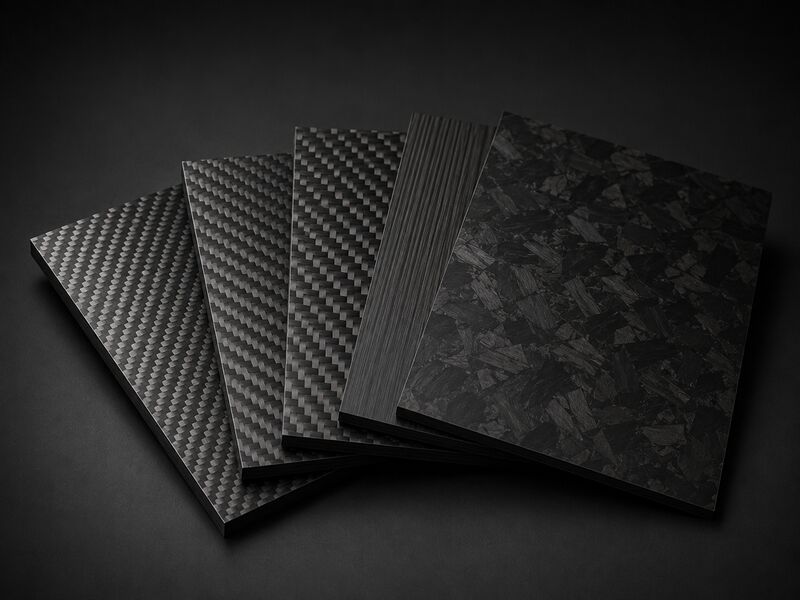
Visible weave characteristics differ between 3K and 12K fabric, influencing cosmetic part selection.
Weave Pattern Visibility
Fine 3K weaves display a tight, detailed carbon fiber pattern often preferred for visible automotive trim and consumer goods. 12K weaves show a bolder, larger-scale pattern that remains popular for certain sporting goods designs.
Gloss and Matte Finishes
Both tow sizes accept gloss or matte clear coats, with final appearance depending more on the coating process than fabric selection.
Surface preparation and resin clarity influence gloss retention regardless of tow size.
Surface Print-Through
Coarser 12K fabric shows more pronounced print-through of the weave pattern beneath thin gel coat or clear coat layers. Finer 3K fabric typically produces smoother surfaces with reduced texture visibility under similar coating thickness.
Manufacturing and Cost
Production efficiency and total component cost depend on tow size interacting with part geometry, laminate thickness, and production volume.
Layup Speed
Wider 12K tows cover surface area faster per pass, reducing layup time for large flat or gently curved panels. 3K fabric requires more manipulation for equivalent coverage, increasing labor cost on larger parts.
Complex Part Handling
Fine 3K fabric drapes more readily over tight curves and complex geometry because of its narrower tow width. 12K fabric may resist conforming smoothly around sharp contours, sometimes causing localized bridging or wrinkling.
Material and Processing Cost
12K fabric generally costs less per kilogram of fiber because of lower weaving complexity and faster production rates. 3K fabric commands a price premium tied to finer weaving tolerances and slower manufacturing speed.
How to Choose 3K or 12K Carbon Fiber
Selection depends on part size, surface requirements, laminate thickness, geometry, and production volume rather than one performance metric.
- Choose 3K fabric for small components, visible cosmetic surfaces, thin laminates, tight curves, and precise thickness control.
- Choose 12K fabric for large panels, thick structural laminates, faster material placement, and lower production cost.
- Use spread-tow 12K when a coarse tow is needed for efficiency but improved surface uniformity and lower crimp are also required.
- Combine both tow sizes when outer plies require a fine cosmetic pattern and inner plies require faster thickness buildup.
- Evaluate fiber grade separately because neither 3K nor 12K automatically indicates higher strength or stiffness.
For finer tow options, see our 1K vs 3K carbon fiber comparison.
Small and Cosmetic Parts
Small components and visible trim pieces typically favor 3K fabric because of its fine pattern and smooth surface finish. Thin laminates also benefit from the finer tow size, which supports precise thickness control.
Thick Structural Laminates
Thicker structural laminates often favor 12K fabric because fewer plies are needed to reach the target thickness. This efficiency becomes significant on large panels requiring substantial laminate buildup.
Production Volume and Part Geometry
High-volume production of large, simple geometries benefits from the material placement speed of 12K fabric. Lower-volume cosmetic parts with complex curves often justify the added handling time required for 3K fabric.
FAQ
What Does K Mean in Carbon Fiber?
The letter K represents one thousand filaments contained within a single continuous tow. A 12K tow therefore contains approximately four times as many filaments as a 3K tow.
Does Tow Size Affect Laminate Strength?
Tow size influences fabric weight, ply thickness, resin distribution, and processing behavior, which can indirectly affect laminate performance. Fiber grade, orientation, volume fraction, and cure quality remain more important strength factors.
Which Tow Size Has a Smoother Finish?
3K fabric generally produces a smoother and finer surface because of tighter weave interlacing. 12K fabric shows a coarser pattern unless spread-tow processing is used.
Can 3K and 12K Be Used Together?
Designers can combine both tow sizes within one laminate to balance surface finish and structural thickness. Outer cosmetic plies may use 3K fabric, while inner structural plies use 12K fabric.