Carbon fiber reinforced polymer often shows higher tensile strength and specific strength than steel along the fiber direction. It is not universally stronger, since steel usually performs more consistently across compression, shear, and multidirectional loads.
What Does Stronger Mean When Comparing Materials?
Strength covers several distinct properties rather than one single number. Comparing CFRP and steel requires separating tensile, compressive, and shear behavior before drawing conclusions.
Tensile Strength Versus Yield Strength
Unidirectional CFRP laminates can reach tensile strengths of roughly 1,500 to 3,000 MPa along the fiber axis, depending on fiber grade and resin system. Structural steels typically yield between 250 and 550 MPa, though high-strength grades reach higher values.
Steel’s yield point marks the start of permanent deformation, while CFRP tensile strength represents the point of fiber fracture.
These are not directly interchangeable measures, since steel retains load-bearing capacity after yielding while CFRP typically does not.
Compressive and Shear Behavior
CFRP compressive strength is generally lower than its tensile strength because fibers can microbuckle under compression. Steel behaves more symmetrically, with similar strength in tension and compression up to yielding.
Shear strength in CFRP depends heavily on the resin matrix and ply stacking, making it more sensitive to manufacturing quality. Steel shear strength remains more predictable across a given grade, simplifying design margins for engineers.
How Does Specific Strength Change the Comparison?
Specific strength divides strength by density, favoring lighter materials when load capacity per unit mass matters. Carbon fiber laminates typically show a clear specific strength advantage over steel because of their significantly lower density.
Density and Weight Efficiency
Steel density is approximately 7,850 kg/m³, while CFRP laminates typically fall between 1,500 and 1,600 kg/m³. This difference means a CFRP part can carry comparable load at a fraction of the mass, provided geometry and fiber orientation are optimized.
If weight reduction is the main reason for considering alternatives to steel, our carbon fiber vs aluminum comparison provides another useful reference.
When Specific Strength Does Not Translate to Real Savings
Higher specific strength does not guarantee a lighter finished part in every design. Stiffness requirements, buckling resistance, or minimum wall thickness may force additional material, reducing the theoretical weight benefit.
Joint design and load introduction points often require local reinforcement in CFRP structures.
Steel components can sometimes achieve similar practical weight in bolted or welded assemblies once these factors are included.
Why Does Fiber Direction Affect Strength Claims?
CFRP is anisotropic, meaning strength varies sharply with fiber orientation. Steel is essentially isotropic, offering similar mechanical behavior regardless of load direction.
Unidirectional Versus Quasi-Isotropic Laminates
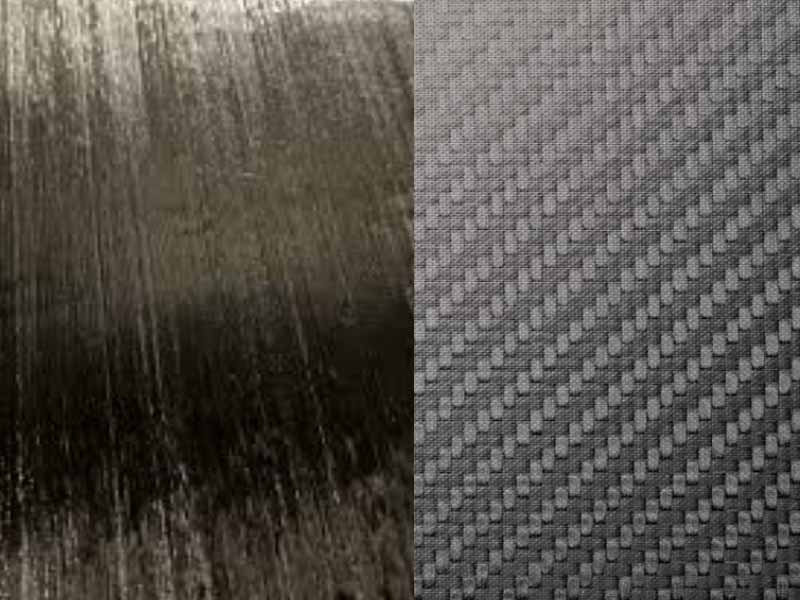
Unidirectional and woven carbon fiber distribute reinforcement differently. Unidirectional laminates deliver peak strength only along the fiber axis, with much lower transverse and interlaminar values. Quasi-isotropic laminates distribute fibers across multiple angles, trading some peak strength for more balanced performance under variable loading.
Matching Laminate Design to Load Path
Engineers select ply orientation based on the expected load path in the finished component. A laminate optimized for one loading condition may underperform steel when loads shift to an unplanned direction.
What Happens Under Impact and Fatigue Loading?
Impact and fatigue behavior often separate CFRP from steel more than static tensile numbers suggest. Both materials can fail under repeated or sudden loading, but the failure mechanisms differ.
Impact Resistance and Damage Visibility
Steel typically deforms visibly before fracturing, providing a warning sign of overload. CFRP can suffer internal delamination or matrix cracking from impact without visible surface damage, complicating inspection.
This difference affects maintenance planning, since hidden CFRP damage may require nondestructive testing methods. Steel structures often allow simpler visual inspection routines during service.
Fatigue Behavior Over Repeated Cycles
CFRP generally shows strong fatigue resistance along the fiber direction when properly designed and manufactured. Steel fatigue performance depends heavily on surface finish, stress concentrations, and weld quality.
How Do Failure Modes Compare?
- Steel yields, then work-hardens before ductile fracture under overload.
- CFRP typically fails through fiber breakage, matrix cracking, or delamination.
- Steel failure is usually gradual and visually detectable.
- CFRP failure can be sudden, especially in compression or impact events.
- Corrosion affects steel over time, while CFRP resists corrosion but remains sensitive to UV and moisture ingress.
These differing failure modes influence how each material is inspected, repaired, and qualified for structural service.
Which Steel Grades Are Relevant for This Comparison?
Steel covers a wide property range, from mild structural steel to high-strength alloy steel. Comparing CFRP against a single steel value oversimplifies a material family with substantial variation.
| Property | CFRP (Unidirectional) | Structural Steel |
|---|---|---|
| Density | 1,500–1,600 kg/m³ | ~7,850 kg/m³ |
| Tensile Strength | 1,500–3,000 MPa | 250–550 MPa (yield) |
| Elastic Modulus | 70–150 GPa (fiber direction) | ~200 GPa |
| Directional Behavior | Highly anisotropic | Isotropic |
Steel’s higher modulus in all directions makes it more predictable for applications requiring uniform stiffness.
For a broader comparison covering weight, stiffness, corrosion, manufacturing, and cost, see our carbon fiber vs steel guide.
How Should Engineers Choose Between Carbon Fiber and Steel?
Material selection depends on load direction, weight targets, budget, and manufacturing capability rather than a single strength figure.
Conditions Favoring Carbon Fiber
- Loads are predictable and align with a defined fiber orientation.
- Weight reduction directly improves system performance.
- Corrosion resistance reduces long-term maintenance needs.
Conditions Favoring Steel
- Multidirectional or unpredictable loading is expected.
- Ductile failure warning is required for safety.
- Lower material and fabrication cost is a priority.
For applications where weight, strength, corrosion resistance, and higher material cost are acceptable trade-offs, see our carbon fiber vs titanium comparison.
FAQ
Is Carbon Fiber Always Stronger Than Steel?
No, carbon fiber is not always stronger than steel in every loading condition. Its strength advantage depends on fiber direction, laminate design, and the specific comparison basis used.
Does Carbon Fiber Have Higher Tensile Strength Than Steel?
Unidirectional CFRP can exceed typical structural steel tensile values along the fiber axis. This advantage decreases significantly for off-axis loading or woven laminate configurations.
Why Is Steel Preferred for Some High-Load Applications?
Steel offers predictable, isotropic strength and visible yielding before failure. These traits simplify design margins and safety verification in critical structural applications.
Can Carbon Fiber Replace Steel in Every Application?
Carbon fiber cannot replace steel in every application without redesign considerations. Cost, joint design, impact tolerance, and multidirectional loading often favor steel in specific structures.