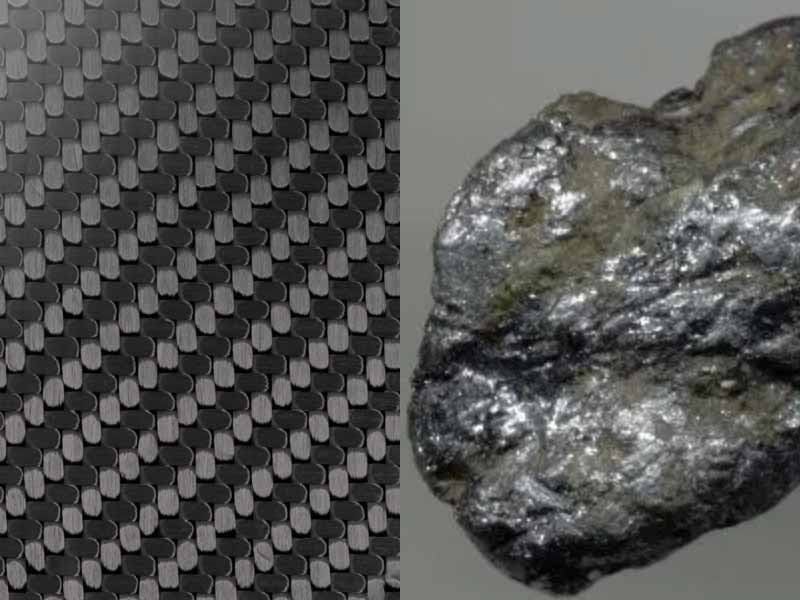
Graphite is a naturally occurring or synthetic crystalline form of carbon with atoms arranged in flat hexagonal sheets.
These sheets stack loosely, which gives graphite its softness and lubricating behavior.
Carbon fiber is a thin filament made mostly of carbon atoms aligned along the fiber axis.
Differences Between Carbon Fiber and Graphite
This section outlines how physical form, function, and terminology separate carbon fiber from graphite in practical use.
Differences in Material Form
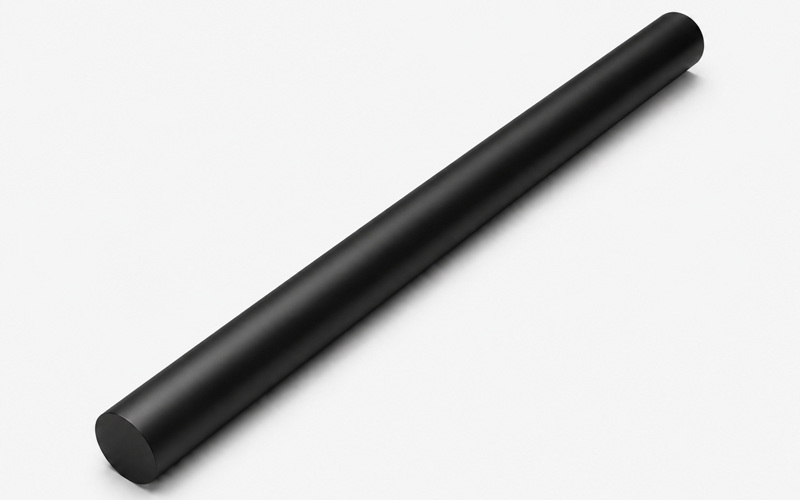
Graphite typically exists as a solid block, powder, or molded shape with no directional fiber structure.
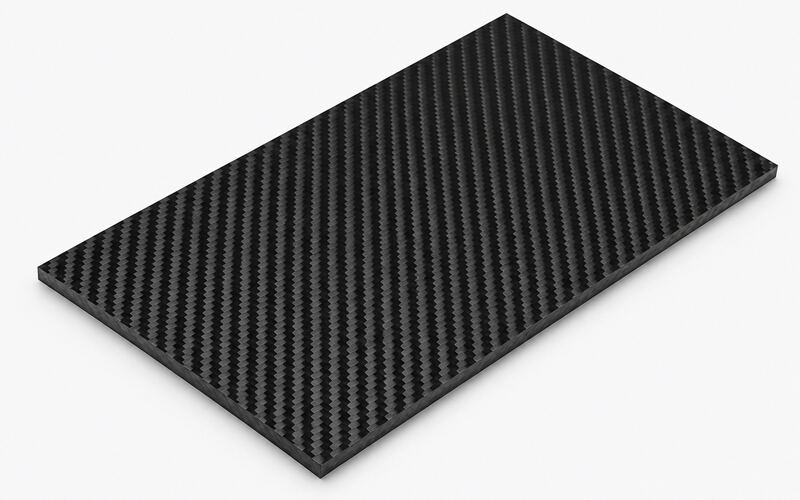
Carbon fiber exists as thin continuous filaments woven into fabric or aligned into tape.
This difference in form directly affects how each material is processed and where it can be applied.
Differences in Structural Function
Carbon fiber provides directional strength and stiffness when embedded in a resin system.
Graphite provides thermal stability and electrical conductivity but limited load-bearing capacity on its own.
Engineers select carbon fiber for structural laminates and select graphite for components that resist heat or conduct current.
This functional split guides material choice across industries.
Differences in Common Terminology
Sporting goods marketing often uses the word graphite to describe carbon fiber rods or shafts.
This is a naming convention rather than a technical distinction.
Why the Two Terms Overlap
The overlap traces back to early carbon fiber products described as graphite composites.
Both materials share the same crystalline carbon structure at the atomic level, which supports the shared naming.
Manufacturers continued the term because consumers recognized graphite as a premium carbon material.
The habit persists even though the fiber form and bulk graphite form behave differently.
| Comparison Aspect | Graphite | Carbon Fiber |
|---|---|---|
| Common form | Solid block, powder, molded shape | Continuous filament, fabric, prepreg tape |
| Processing method | Machined | Layered and cured in resin matrix |
| Primary function | Thermal stability, electrical conductivity | Directional strength and stiffness |
| Common terminology | Technical / literal | Often marketed as “graphite” in sporting goods |
Material Composition and Structure
This section compares atomic arrangement and internal structure between carbon fiber and bulk graphite forms.
Atomic Structure of Graphite
Graphite consists of stacked hexagonal carbon layers held together by weak interlayer bonds.
These weak bonds allow layers to slide, which explains graphite’s softness and lubricating property.
Internal Structure of Carbon Fiber
Carbon fiber contains graphitic crystal planes aligned parallel to the fiber length rather than stacked randomly.
This alignment gives carbon fiber high tensile strength along its axis compared to bulk graphite.
The degree of crystal alignment depends on processing temperature and tension during manufacturing.
Better alignment increases stiffness but can reduce strain tolerance in the finished fiber.
Continuous Fibers and Bulk Graphite
Continuous carbon fiber tows run in one direction and carry load along that axis. Bulk graphite has no directional reinforcement, so its strength is roughly uniform in all directions but lower overall.
Carbon Fiber in a Resin Matrix
Carbon fiber alone cannot hold a shape or resist compression without support. Resin, typically epoxy, binds the fibers together and transfers load between filaments in a carbon fiber laminate.
Resin content directly affects weight, stiffness, and surface finish of the cured part.
Controlling resin content within the specified range improves fiber volume fraction and mechanical consistency.
Carbonization and Graphitization
This section explains the thermal processes that convert precursor fiber into carbon fiber and, further, into graphite fiber.
How Carbon Fiber Is Carbonized
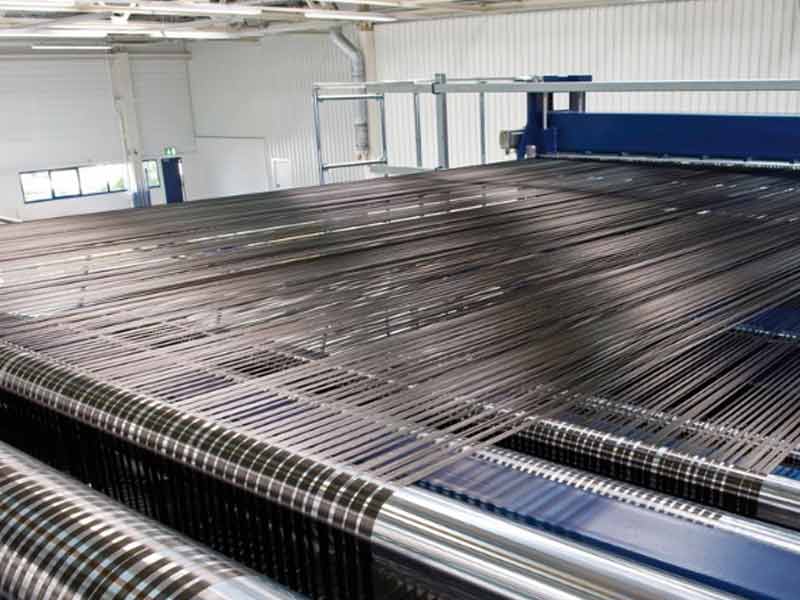
Carbon fiber production starts with a precursor, usually polyacrylonitrile, which is oxidized and then heated in an inert atmosphere. Carbonization removes non-carbon elements and leaves a fiber that is roughly 90 to 95 percent carbon.
Carbonization temperature controls the final carbon content and crystal structure.
Higher carbonization temperatures increase modulus but can reduce tensile strain capability if not carefully managed.
How Graphitization Changes Fiber Structure
Graphitization applies even higher heat treatment, often near 3000 °C, to increase carbon purity and crystal alignment.
This process raises modulus significantly by improving the parallel orientation of graphitic planes.
However, graphitization can lower tensile strength and increase brittleness in the fiber.
When Carbon Fiber Becomes Graphite Fiber
Carbon fiber is often called graphite fiber once carbon content and crystal alignment reach a high enough level. There is no single fixed threshold, so the terms are used somewhat interchangeably in industry practice.
- Precursor (usually polyacrylonitrile) is spun into filaments.
- Filaments are oxidized to stabilize their structure.
- Carbonization in an inert atmosphere removes non-carbon elements, leaving ~90–95% carbon.
- Optional graphitization at temperatures near 3000 °C further raises carbon purity and modulus.
- The resulting fiber may then be marketed as “carbon fiber” or “graphite fiber” depending on the degree of graphitization.
Mechanical Property Comparison
This section compares strength, stiffness, and fracture behavior between carbon fiber composites and bulk graphite parts.
Tensile Strength and Specific Strength
Carbon fiber composites deliver high tensile strength relative to their weight because load travels along aligned fibers.
Bulk graphite has much lower tensile strength since it lacks directional reinforcement and contains natural porosity.
Specific strength, which accounts for density, favors carbon fiber composites in nearly all structural applications.
This is why carbon fiber replaces metal in weight-sensitive structural parts, while graphite is reserved for non-structural or thermal roles.
Stiffness and Elastic Modulus
Carbon fiber modulus depends on the precursor and heat treatment used during manufacturing, ranging from standard to ultra-high modulus grades. Graphite’s stiffness is fixed by its crystal structure and cannot be tuned like fiber modulus.
This tunability lets engineers select a carbon fiber grade that matches stiffness targets for a specific part.
Graphite offers no equivalent flexibility since it is used mainly as a bulk solid.
Impact Resistance and Fracture Behavior
Carbon fiber laminates can absorb impact energy through fiber-resin interaction and controlled delamination.
Bulk graphite is brittle and tends to fracture suddenly under impact without warning.
Layup design, including ply orientation and stacking sequence, influences how a carbon fiber part responds to impact.
Poor layup design can lead to premature cracking or delamination under sudden loads.
Fatigue Resistance in Composite Parts
Carbon fiber composites generally show strong fatigue resistance when fiber volume fraction and void content are well controlled. Voids above the specified limit create stress concentrations that accelerate fatigue crack growth.
Graphite is rarely used in cyclic loading applications due to its brittleness and lack of fiber reinforcement. This makes fatigue comparison less relevant outside of carbon fiber composite design.
| Property | Bulk Graphite | Carbon Fiber Composite |
|---|---|---|
| Tensile strength | Low (porosity, no directionality) | High (along aligned fiber axis) |
| Specific strength | Low | High — favored in structural applications |
| Stiffness / modulus | Fixed by crystal structure | Tunable (standard to ultra-high modulus) |
| Impact behavior | Brittle, sudden fracture | Absorbs energy via fiber-resin interaction |
| Fatigue resistance | Poor / rarely applicable | Strong with controlled void content |
Density and Weight Comparison
This section reviews how density and resin content influence the final weight of carbon fiber and graphite components.
Density of Carbon Fiber and Graphite
Carbon fiber has a density near 1.8 g/cm³, while bulk graphite density varies depending on porosity and grade.
Both are lighter than most structural metals, but carbon fiber composites benefit more from this low density due to their high strength.
Weight of Finished Composite Parts
A finished carbon fiber part’s weight depends on fiber areal weight, resin content, and laminate thickness.
Thinner laminates with optimized ply count reduce weight while maintaining required stiffness.
Graphite components are typically heavier for equivalent structural performance because they lack directional fiber reinforcement.
This weight difference is a primary reason carbon fiber dominates weight-critical applications.
Effect of Resin Content on Weight
Higher resin content increases part weight without adding proportional strength, since resin carries less load than fiber.
Controlling resin content near the specified target improves the strength-to-weight ratio and reduces excess mass.
Excess resin can also create resin-rich pockets that weaken interlaminar bonding.
Proper vacuum bagging or autoclave pressure control helps maintain consistent resin distribution.
Thermal and Electrical Properties
This section compares how carbon fiber and graphite conduct heat and electricity under different operating conditions.
Electrical Conductivity Differences
Graphite conducts electricity well due to delocalized electrons within its layered structure, making it useful for electrodes.
Carbon fiber is also conductive along its length but less uniformly conductive than solid graphite.
This difference affects grounding and shielding design in carbon fiber composite structures.
Thermal Conductivity Differences
Graphite conducts heat efficiently in the direction parallel to its crystal layers, which supports its use in heat sinks.
Carbon fiber conductivity depends heavily on fiber grade and orientation within the laminate.
High modulus carbon fiber generally conducts heat better than standard modulus fiber due to improved crystal alignment.
Heat Resistance at High Temperatures
Bulk graphite withstands extremely high temperatures without melting, making it suitable for furnace and aerospace thermal components. Carbon fiber composites are limited by their resin matrix, since most epoxy systems degrade above roughly 200 °C.
Selecting a high-temperature resin extends the usable range of a carbon fiber part.
Oxidation in High Temperature Environments
Both graphite and carbon fiber oxidize when exposed to oxygen at very high temperatures. Protective coatings or inert atmospheres are used to limit oxidation damage in demanding thermal applications.
Carbon Fiber Modulus Grades
This section explains how different carbon fiber modulus grades affect stiffness, durability, and part design choices.
Standard Modulus Carbon Fiber
Standard modulus carbon fiber offers a balanced combination of stiffness and strain tolerance for general structural use.
It is the most common and cost-effective grade used in automotive and sporting goods parts.
This grade suits applications where moderate stiffness and good impact tolerance are both required.
It also processes well with standard curing and molding methods.
Intermediate and High Modulus Grades
Intermediate modulus fiber increases stiffness while retaining reasonable strain capability compared to standard grades.
High modulus fiber pushes stiffness further but typically sacrifices some tensile strain tolerance in the process.
These grades are chosen when deflection control matters more than impact resistance.
How Modulus Affects Stiffness?
Modulus directly measures a fiber’s resistance to elastic deformation under load.
A higher modulus grade produces a stiffer part for the same laminate thickness and layup design.
Designers adjust ply count and orientation alongside modulus selection to meet stiffness targets.
Using a higher modulus fiber can sometimes reduce laminate thickness while maintaining equivalent bending resistance.
Tradeoff Between Stiffness and Durability
Higher modulus fibers tend to be more brittle and less tolerant of sudden impact loads.
This tradeoff means designers must balance stiffness gains against increased risk of fiber breakage under shock loading.
Manufacturing and Processing Differences
This section covers how carbon fiber, composite parts, and bulk graphite are each produced and processed.
How Carbon Fiber Is Produced
Carbon fiber production begins with spinning a precursor into fine filaments, followed by oxidation and carbonization stages. Tension and temperature control during these stages determine final fiber diameter, modulus, and strength.
Inconsistent tension can cause fiber waviness that weakens the final composite. Tight process control at each stage is essential for consistent fiber quality across a production batch.
How Carbon Fiber Composites Are Molded
Carbon fiber fabric or prepreg is laid into a mold according to a specified ply schedule and orientation.
Curing under controlled temperature and pressure, often in an autoclave, consolidates the laminate and cures the resin.
Incorrect curing temperature can cause incomplete resin cure or excess void content.
Proper vacuum bagging and pressure control reduce porosity and improve interlaminar strength.
How Bulk Graphite Is Manufactured
Bulk graphite is produced by baking carbon-rich raw materials, such as petroleum coke, at very high temperatures over extended periods. This process, distinct from carbon fiber carbonization, forms dense graphite blocks or rods.
These blocks are then machined into final shapes since graphite does not use a resin matrix.
Machining parameters affect surface finish and the risk of chipping in brittle graphite parts.
How Processing Affects Material Quality
Both materials are sensitive to processing temperature, atmosphere, and handling during manufacturing.
Poor process control can introduce porosity, cracking, or inconsistent mechanical properties in either material.
Cost and Production Factors
This section reviews how raw material choice, fiber grade, and production method influence overall part cost.
Raw Material Cost Differences
Carbon fiber precursor and multi-stage thermal processing make it more expensive than bulk graphite raw material. Graphite raw material and simpler processing keep bulk graphite costs comparatively lower for equivalent volume.
Cost of Higher Modulus Fibers
Higher modulus carbon fiber requires additional graphitization steps at elevated temperature, which increases processing cost.
This added cost is justified only when stiffness requirements cannot be met by standard modulus fiber.
Designers weigh performance gains against this cost increase during material selection.
Overspecifying modulus grade adds cost without improving part function in many applications.
Machining and Molding Costs
Carbon fiber composite parts require mold tooling, layup labor, and controlled curing cycles, all of which add cost.
Bulk graphite parts are machined directly from solid stock, which can reduce tooling cost but increase material waste.
Complex geometries raise costs differently for each material, since composite layup handles curves more easily than graphite machining. Tolerance requirements also affect finishing time and inspection cost for both material types.
Production Volume and Part Cost
Carbon fiber composite cost per part tends to decrease with higher production volume due to tooling amortization.
Graphite machining cost scales more directly with material removal time regardless of volume.
Common Uses of Carbon Fiber and Graphite
This section highlights typical applications where carbon fiber composites and bulk graphite are each preferred.
Carbon Fiber in Structural Composites
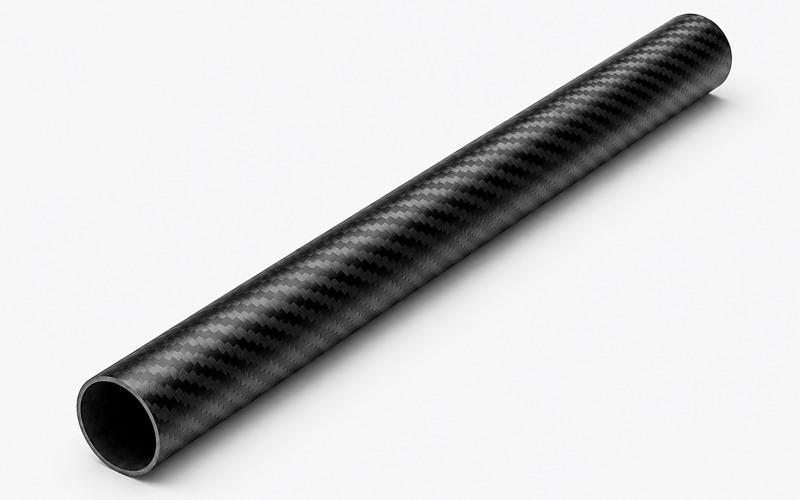
Carbon fiber composites are used in aerospace panels, automotive body parts, and structural tubes where weight and stiffness matter.
Fiber orientation and layup design are tailored to the load path of each specific part.
This makes carbon fiber the preferred choice for load-bearing structures across multiple industries.
Its combination of low density and high specific strength cannot be matched by bulk graphite.
Graphite in High Temperature Parts
Graphite is used in furnace linings, crucibles, and electrodes that must withstand extreme heat without structural loading.
Its high temperature stability makes it suitable where carbon fiber’s resin matrix would fail.
Graphite in Electrical Applications
Graphite serves as electrodes in batteries and electrolysis processes due to its electrical conductivity and chemical stability.
This application relies on graphite’s bulk conductivity rather than any fiber reinforcement.
Carbon Materials in Sports Equipment
Carbon fiber composites dominate sports equipment such as bicycle frames, tennis rackets, and fishing rods.
Manufacturers select fiber modulus and layup based on the flex and strength needs of each product.
Carbon Fiber and Graphite Fishing Rods
This section explains why fishing rod blanks are marketed under both carbon fiber and graphite naming conventions.
Why Rod Blanks Use Both Terms
Fishing rod manufacturers often label carbon fiber rods as graphite rods due to long-standing marketing tradition.
Both terms refer to the same carbon fiber composite material in most modern rod blanks.
How Modulus Affects Rod Sensitivity
Higher modulus fiber increases rod stiffness, which improves sensitivity to small vibrations from a biting fish.
However, higher modulus rods can feel less forgiving and more prone to breakage under sudden shock loads.
Rod designers blend modulus grades across sections to balance sensitivity with durability.
This layered approach lets anglers feel subtle strikes while retaining enough toughness for fighting larger fish.
How Fiber Layup Affects Durability
Fiber orientation and wall thickness in a rod blank determine how it distributes bending stress along its length. Poor layup design can create weak points that crack under repeated flexing.
Manufacturers adjust ply angle and thickness to match expected load conditions for casting and fighting fish. Consistent layup control reduces the risk of premature blank failure.
Choosing the Right Rod Material
Anglers select rod modulus based on target species, casting style, and desired sensitivity.
Lower modulus rods offer more forgiveness, while higher modulus rods offer sharper feedback and lighter weight.
Choosing Carbon Fiber or Graphite
This section summarizes the main factors that guide selection between carbon fiber composites and bulk graphite.
When Carbon Fiber Is the Better Choice
Carbon fiber suits applications needing high strength-to-weight ratio and directional load control. Structural parts, panels, and sporting goods generally benefit most from carbon fiber composite construction.
When Graphite Is the Better Choice
Graphite suits applications requiring high temperature stability or electrical conductivity without structural load demands. Furnace components and electrodes are typical examples where bulk graphite outperforms carbon fiber composites.
Key Material Selection Factors
Selection depends on load type, temperature exposure, weight targets, and budget constraints. Reviewing these factors together helps determine whether a carbon fiber composite or bulk graphite part fits the application.
- Choose carbon fiber for high strength-to-weight, directional load control, and weight-critical structural parts.
- Choose graphite for extreme heat resistance, electrical conductivity, and non-structural thermal components.
- Weigh selection factors together: load type, temperature exposure, weight targets, and budget.
FAQ
Is Carbon Fiber Made From Graphite?
Carbon fiber is not made directly from graphite but shares its crystalline carbon structure. It is produced from a precursor material through carbonization and optional graphitization.
What is Graphite Fiber?
Graphite fiber refers to carbon fiber that has undergone additional high temperature graphitization for higher modulus. The term is often used interchangeably with high modulus carbon fiber.
Why is Carbon Fiber Called Graphite?
The naming comes from marketing tradition and the shared crystalline carbon structure between the two materials. This usage continues in sporting goods despite the technical differences in form and function.