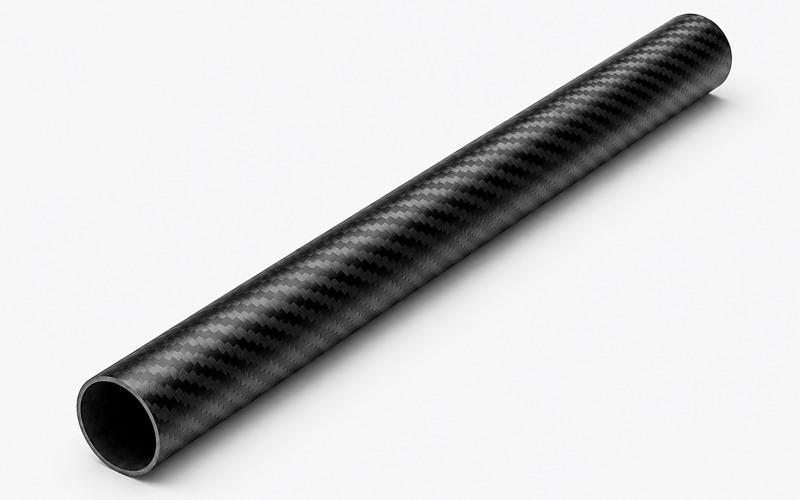
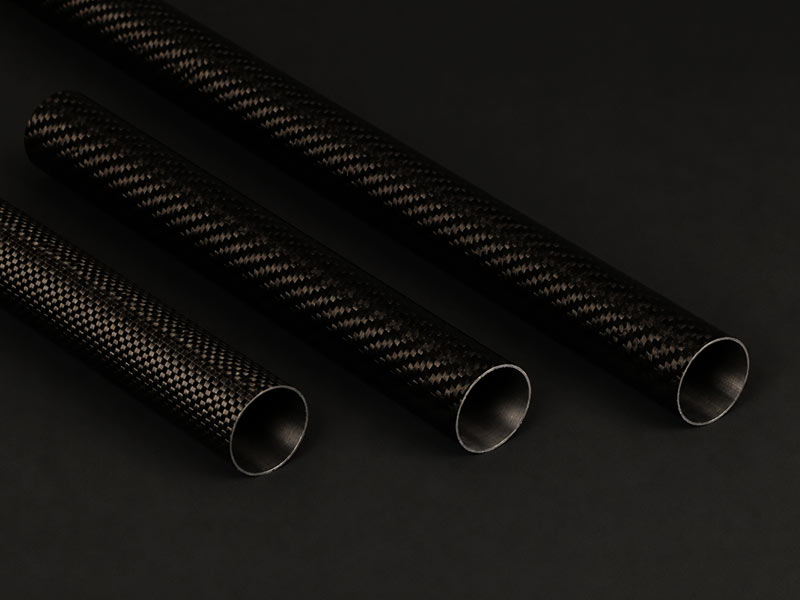
Carbon fiber tubes are used for structural components that need to be lightweight, stiff, and dimensionally stable. Engineers select them for robotic arms, drone frames, industrial shafts, and precision instruments. These applications share common demands: reduced mass, high bending stiffness, and resistance to fatigue over long service cycles.
Carbon fiber tubes are a form of carbon fiber reinforced polymer, or CFRP. Continuous carbon filaments are bundled into tows, then arranged as unidirectional layers or woven fabric. These layers are combined with a resin system and cured into a tubular laminate.
Tube performance depends on fiber orientation, wall thickness, resin type, and manufacturing method. A tube built for bending loads differs from one built for torsional loads. Selecting the right tube means matching construction to the actual load case.
Common Applications of Carbon Fiber Tubes
These are some of the most common carbon fiber applications where tubular structures provide a useful combination of low weight and stiffness.
Robotic arms and automation systems
Robotic arm segments use carbon fiber tubes to cut moving mass without losing stiffness. Lower mass reduces motor torque demand and improves positioning speed. This directly increases cycle rates in pick-and-place and assembly systems.
Round or square carbon fiber tubes are common because they resist bending deflection along the arm length. Reduced deflection improves repeatability in high-precision automation tasks.
Industrial shafts and rollers
Carbon fiber tubes replace metal shafts in printing, packaging, and material handling equipment. Lower rotational inertia allows faster acceleration and deceleration cycles. This reduces motor load and energy consumption over continuous operation.
High stiffness prevents shaft whip at elevated rotational speeds. This is critical in roller systems where vibration affects product quality.
Drone frames and camera equipment
UAV frames use carbon fiber tubes for arms and booms because weight directly affects flight time. Reduced structural mass allows more payload capacity or longer endurance.
Camera stabilization booms and gimbal arms use small-diameter tubes for the same reason. Stiffness keeps optical components aligned during movement.
Scientific and optical instruments
Optical benches and instrument supports use carbon fiber tubes because of low thermal expansion. Dimensional stability under temperature change protects alignment accuracy.
This matters in laser systems, telescopes, and metrology equipment where micron-level positioning is required.
Why Carbon Fiber Tubes Are Used
Strength-to-weight ratio
Carbon fiber tubes carry structural loads at a fraction of the weight of steel or aluminum tubing. This allows engineers to reduce moving mass in dynamic systems. Lower mass reduces inertia, energy use, and mechanical wear.
For a broader material comparison covering weight, stiffness, corrosion, and manufacturing, see our carbon fiber vs aluminum guide.
Stiffness and dimensional stability
Carbon fiber has a high modulus relative to its density. Tubes resist bending under load without adding wall thickness. This keeps components lightweight while maintaining shape accuracy.
Torsional and bending performance
Fiber orientation controls how a tube resists twisting versus bending. Layup angles can be tuned to prioritize one load type over another. This flexibility supports applications with mixed load conditions.
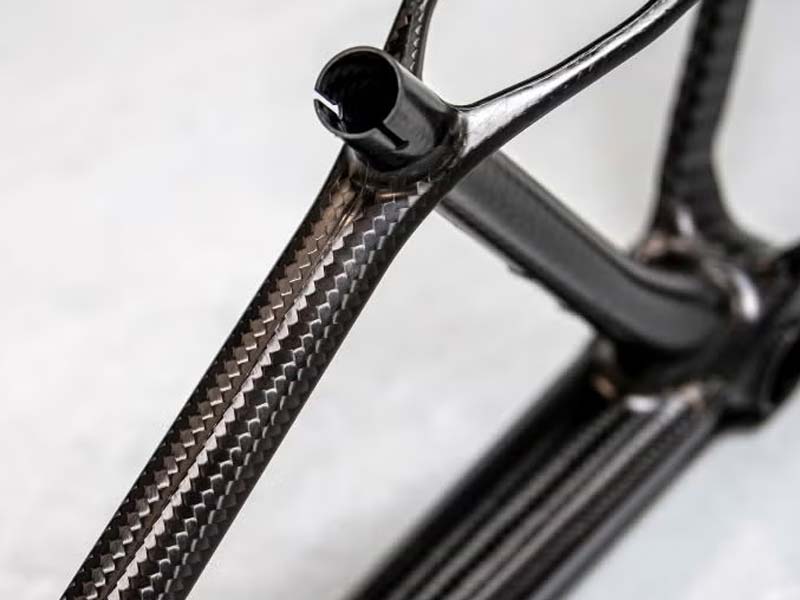
Industrial Carbon Fiber Tube Uses
Motion systems and linear actuators
Linear motion systems use carbon fiber tubes as guide rails or push rods. Reduced mass allows faster stroke cycles with less servo strain.
Lower inertia also reduces settling time after rapid motion changes.
Precision equipment structures
Semiconductor and metrology equipment use carbon fiber tubes for structural frames. Stiffness prevents deflection that would affect measurement accuracy.
Lightweight mechanical components
General mechanical assemblies use carbon fiber tubes wherever mass reduction improves system efficiency. This includes support struts, brackets, and connecting members.
Transportation Applications
Aircraft structures
Aircraft use carbon fiber tubes in interior structures, control rod linkages, and support frames. Weight savings translate directly into fuel efficiency gains.
Fatigue resistance supports long service life under repeated flight cycles.
Drone components
Beyond frame arms, drones use carbon fiber tubes for landing gear and payload mounts. Stiffness prevents structural flex during flight maneuvers.
Motorsports parts
Racing applications use carbon fiber tubes for suspension links and structural bracing. Reduced unsprung mass improves handling response.
Specialized Carbon Fiber Tube Uses
Medical equipment structures
Medical imaging tables and mobile equipment frames use carbon fiber tubes for weight reduction. Lower weight improves portability without sacrificing structural support.
Camera and measurement equipment
Tripod legs, boom poles, and stabilizer rigs use carbon fiber tubes for vibration damping. This improves image stability during handheld or mounted operation.
Telescopic supports
Telescoping carbon fiber tube sections are used in extendable poles and mast systems. Thin walls keep weight low while maintaining column strength.
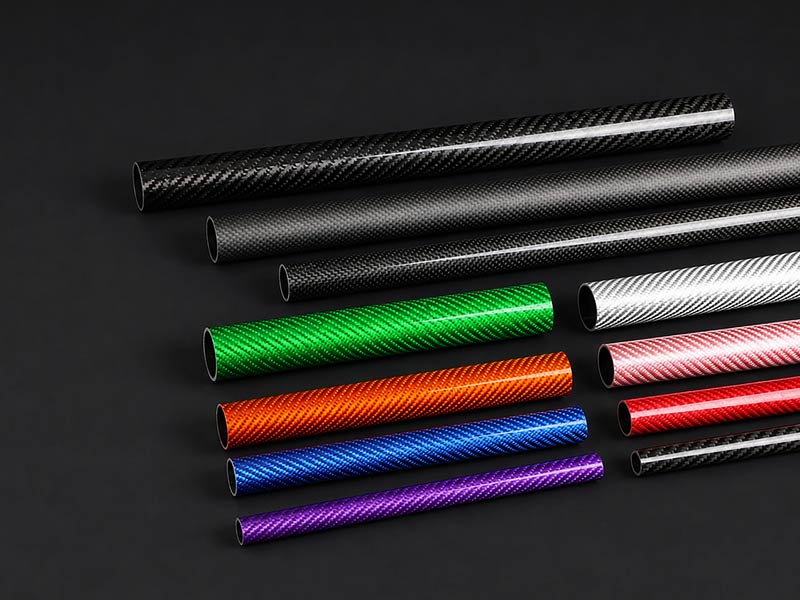
Carbon Fiber Tube Construction
Roll wrapped and filament wound tubes
Roll wrapped tubes use prepreg sheets rolled around a mandrel, giving controlled wall thickness and fiber angle. Filament winding wraps continuous tow under tension, suited for tubes needing high torsional strength.
Pultruded carbon fiber tubes
Pultrusion pulls fiber through a resin bath and heated die, producing straight tubes with consistent cross-section. This process suits long, constant-profile tubes at lower cost.
Fiber orientation and wall thickness
Fiber angle determines whether a tube resists bending, torsion, or both. Wall thickness affects buckling resistance and overall stiffness.
| Construction Method | Typical Use Case | Key Advantage |
|---|---|---|
| Roll wrapped | Custom diameter tubes | Controlled fiber angle |
| Filament wound | High-torque shafts | Strong torsional performance |
| Pultruded | Long straight tubes | Cost-efficient production |
Selecting Carbon Fiber Tubes
Diameter and wall thickness
Larger diameters increase bending stiffness without adding much weight. Wall thickness affects load capacity and impact resistance.
Load direction and torque requirements
Bending-dominant applications need different fiber layups than torsion-dominant ones. Engineers define load direction before selecting tube construction.
Joining and machining requirements
Bonded inserts, clamped fittings, and machined ends affect tube design. When cutting carbon fiber tubes, the tooling and cutting method must limit delamination and edge damage.
Wall thickness must support the chosen joining method without weakening the structure.
- Confirm required stiffness and load direction
- Select diameter and wall thickness accordingly
- Choose construction method based on load type
- Plan joining method before finalizing tube ends