A typical cured CFRP laminate has a density near 1.5 to 1.6 g/cm³. Many common plastics fall between 0.9 and 1.5 g/cm³, so several plastics are actually less dense than CFRP by volume.
Density alone does not determine finished-part weight. A plastic component often needs thicker walls to reach the same stiffness as a CFRP part.
Because CFRP resists bending with less material, the finished carbon fiber part can end up lighter despite its higher raw density.
What Materials Are Being Compared?
Clarifying which carbon fiber form and which plastic type are involved is necessary before comparing weight.
Carbon Fiber Filament Versus CFRP Composite
Raw carbon filaments have very high tensile properties but cannot be used alone as a structural part.
Finished components use CFRP laminates, where fiber orientation, resin content, and cure quality determine the actual density and performance.
Unfilled and Reinforced Plastics
Unfilled thermoplastics such as polypropylene or polyethylene have low density and low stiffness.
Why Carbon Fiber Is Usually Combined With Resin
Carbon fibers cannot transfer load into a usable shape without a resin matrix binding them together.
The resin also adds mass, which is why CFRP density sits above the density of dry carbon fiber alone.
Carbon Fiber and Plastic Density Compared
Comparing density values at equal volume shows where each material stands before part geometry is considered.
Density of Common Plastics
Polypropylene and polyethylene range from about 0.90 to 0.97 g/cm³. Engineering plastics such as nylon, polycarbonate, and ABS typically range from 1.04 to 1.4 g/cm³.
Typical Density of CFRP
A standard CFRP laminate with 55 to 65 percent fiber volume fraction typically measures 1.5 to 1.6 g/cm³.
Higher resin content lowers this value slightly, while higher fiber content raises it.
How Resin Content Affects Composite Density?
Carbon fiber itself has a density near 1.8 g/cm³, while common epoxy resin is closer to 1.1 to 1.3 g/cm³.
Which Material Is Lighter at Equal Volume?
At equal volume, low-density plastics like PP and PE are lighter than CFRP. Engineering plastics with fillers can approach or exceed CFRP density depending on filler type and loading.
| Material | Typical Density (g/cm³) |
|---|---|
| Polypropylene (PP) | 0.90 – 0.91 |
| Polyethylene (PE) | 0.92 – 0.97 |
| Nylon (unfilled) | 1.13 – 1.15 |
| Polycarbonate | 1.20 – 1.22 |
| Glass-filled Nylon | 1.35 – 1.45 |
| CFRP Laminate | 1.50 – 1.60 |
Equal Volume Versus Equal Performance
The comparison basis changes the outcome, since equal volume and equal performance rarely lead to the same conclusion.
Same Size and Thickness Comparison
If both parts share identical dimensions, most unfilled plastics weigh less than CFRP because their density is lower. This comparison ignores whether either part can actually support the intended load.
Same Strength Comparison
When matched for equal tensile or flexural strength, plastic often requires a thicker or reinforced section.
CFRP typically reaches the required strength with a thinner, lighter cross-section.
Same Stiffness Comparison
Plastic has a much lower elastic modulus than CFRP along its fiber direction. To match CFRP stiffness, a plastic part may need several times more material, increasing its final weight beyond the composite.
 Why Carbon Fiber Parts Can Weigh Less?
Structural efficiency, not raw density, usually explains why CFRP components end up lighter than plastic equivalents.
Higher Stiffness Allows Thinner Sections
CFRP modulus values along the fiber direction can reach 70 to 150 GPa, compared with 1 to 3 GPa for common plastics. This stiffness gap allows CFRP walls to be significantly thinner while resisting the same deflection.
Higher Strength Can Reduce Material Use
CFRP tensile strength in the fiber direction often exceeds plastic tensile strength by a wide margin.
Less material is needed to carry the same load, which lowers the total part mass.
Fewer Ribs and Supports May Be Required
Plastic housings frequently rely on internal ribs to compensate for low stiffness.
When Plastic Is the Lighter Choice?
Plastic remains the lighter option whenever loads are low and thin sections are not limited by stiffness requirements.
Low Density Plastics Such as PP and PE
For nonstructural parts, PP and PE offer lower density than CFRP with no performance penalty.
Their weight advantage holds as long as thickness stays similar between designs.
Nonstructural Covers and Housings
Covers, trim panels, and light housings rarely need CFRP-level stiffness. In these cases, thin molded plastic is lighter and considerably less expensive.
Thin Injection Molded Components
Injection molding allows very thin plastic walls when structural loads are minimal.
This manufacturing advantage can outweigh any density difference with CFRP for small, low-load parts.
When Carbon Fiber Produces a Lighter Part?
Carbon fiber becomes the lighter solution once stiffness, strength, or space constraints dominate the design requirement.
Stiffness Critical Structural Components
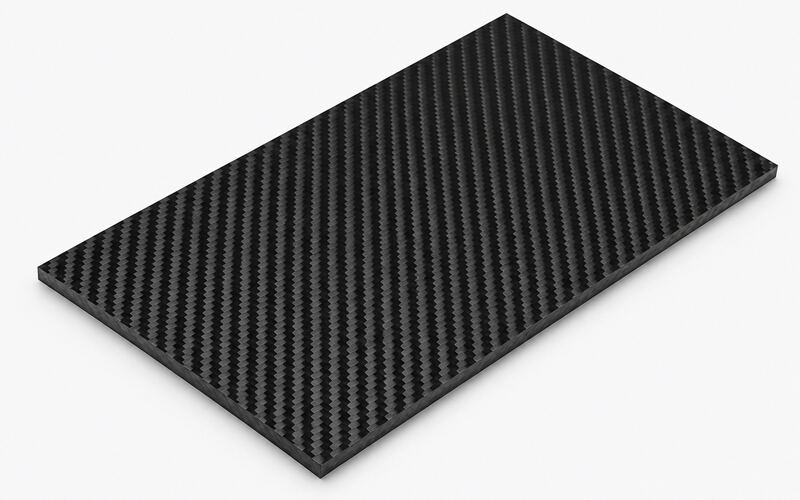
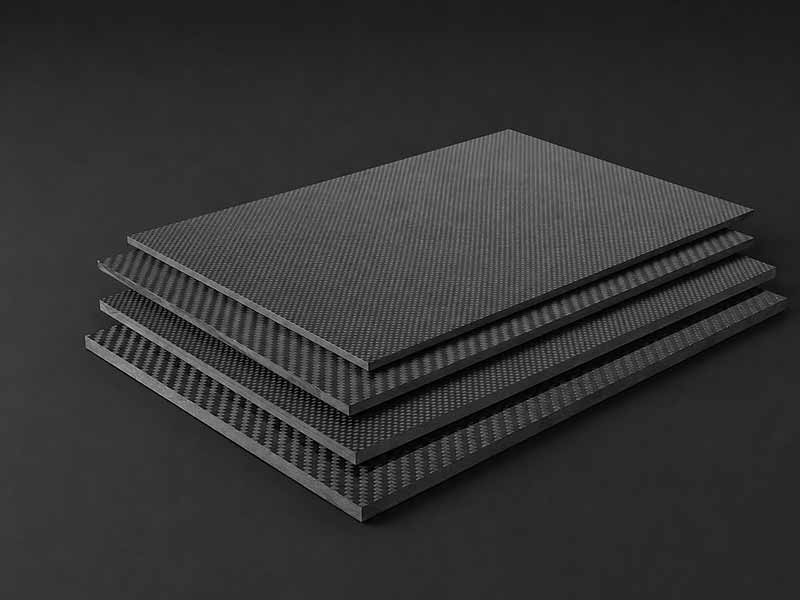
When deflection limits govern the design, CFRP reaches target stiffness with far less mass than plastic. Flat carbon fiber panels and structural covers benefit most from this behavior, especially where bending stiffness limits the design.
High Load Parts With Limited Space
Where thickness is restricted, plastic cannot always meet strength targets without excessive bulk.
CFRP carries higher loads within the same envelope, keeping the part lighter and compact.
Aerospace Automotive and Sports Applications
Many carbon fiber applications in aerospace, automotive, and sports equipment prioritize stiffness-to-weight performance over raw material density.
Aircraft panels, automotive structural parts, and sports equipment often replace plastic or metal with CFRP for stiffness-critical zones. These applications prioritize load-carrying efficiency over raw material cost.
Where aluminum is the main lightweight metal alternative, our carbon fiber vs aluminum comparison explains the differences in density, stiffness, strength, corrosion resistance, and cost.
Other Factors Beyond Weight
Weight is one factor among several that influence material selection for a given component.
Impact Resistance and Damage Behavior
Many plastics deform or flex under impact without fracturing, absorbing energy gradually. CFRP can be strong yet more brittle, with impact damage sometimes occurring beneath the visible surface.
Creep and Temperature Performance
Plastics are more prone to creep under sustained load, especially at elevated temperature.
Manufacturing Cost and Production Volume
Injection molded plastic suits high-volume production with low per-part cost. CFRP manufacturing involves layup, curing, and tooling steps that raise cost, particularly at low production volumes.
Choosing Between Carbon Fiber and Plastic
Material selection should follow the load case and performance target rather than density figures alone.
Choose Plastic for Low Loads and Low Cost
Plastic suits parts with minimal structural demand, high production volume, and tight cost targets.
Its lower density benefits weight only when wall thickness stays small.
Choose CFRP for Structural Weight Reduction
CFRP suits components where stiffness or strength per unit weight matters more than raw material cost. It typically produces the lighter structural solution once load requirements increase.
Compare Complete Parts Instead of Density Alone
A fair comparison requires matching the parts by strength, stiffness, or load capacity, not simply volume. Finished-part testing or calculation gives a more reliable answer than density tables alone.
- Match comparison basis: volume, strength, or stiffness.
- Check plastic type: unfilled, filled, or reinforced.
- Confirm CFRP fiber volume fraction and layup.
- Consider load direction relative to fiber orientation.
- Account for wall thickness needed to meet requirements.
FAQ
Is Carbon Fiber Lighter Than Every Type Of Plastic?
No, some low-density plastics such as polypropylene and polyethylene are lighter than CFRP by volume. CFRP only becomes lighter once equal strength or stiffness is required.
What Is The Typical Density Of CFRP?
Most standard CFRP laminates range from 1.5 to 1.6 g/cm³, depending on fiber volume fraction and resin type. Higher fiber content generally increases this value slightly.
Does Adding Carbon Fiber Make Plastic Lighter?
Carbon fiber reinforcement usually increases the density of a plastic compound rather than reducing it. Any weight savings come from being able to use thinner sections, not from lower material density.
Can Carbon Fiber Parts Be Thinner Than Plastic Parts?
Yes, CFRP’s higher stiffness and strength allow thinner sections to meet the same performance target. This thickness reduction is the main reason CFRP parts can weigh less despite higher density.
Why Can A Plastic Part Weigh Less Than CFRP?
When loads are low and wall thickness stays minimal, plastic’s lower density gives it a direct weight advantage. This applies mainly to nonstructural or lightly loaded components.